





Kangchenjunga, Sikkim: The Five Treasures
The world's third-highest peak, Kangchenjunga, isn't just a mountain; it's a deity. Its name translates to the "Five Treasures of the Great Snow," believed to hold gold, silver, gems, grain, and sacred texts. Local Lepcha communities believe the first
man and woman were created from its snow. So sacred is this peak that mountaineers traditionally stop just short of the summit out of respect for the spirits said to dwell at the top, a promise kept to the former Sikkimese king.
Nanda Devi, Uttarakhand: The Bliss-Giving Goddess
Soaring majestically in the Garhwal Himalayas, Nanda Devi is revered as the “Bliss-Giving Goddess.” Folklore tells of a beautiful princess named Nanda who, fleeing from a tyrannical king, sought refuge on the mountain and became one with it, transforming into a protective deity. The peak is seen as an incarnation of Parvati, Lord Shiva's consort. This deep reverence is also linked to the tragic mystery of Roopkund, the nearby glacial lake filled with human skeletons, which local tales attribute to a group of pilgrims who angered the goddess with their disrespectful celebrations.
Trikuta Mountains, Jammu: The Cave of Vaishno Devi
The three-peaked Trikuta mountain is home to one of India's most sacred shrines, Vaishno Devi. Legend holds that the goddess Vaishnavi, a combined form of Mahakali, Mahalakshmi, and Mahasaraswati, meditated in a cave here on the instruction of Lord Rama. The story follows her journey as she was pursued by the tantric Bhairav Nath. She eventually defeated him at the mouth of the cave where she had taken refuge. Today, millions of pilgrims trek to the holy cave to worship the goddess in the form of three natural rock formations called Pindis.
Chamundi Hills, Karnataka: Lair of the Demon King
Overlooking the city of Mysuru, the Chamundi Hills are named for the warrior goddess Chamundeshwari, a fearsome form of Durga. The hill is the fabled battleground where the goddess vanquished the buffalo-headed demon Mahishasura. In fact, the name of the city itself, Mysuru, is said to have evolved from 'Mahishooru' or the land of Mahisha. A striking, colourful statue of the demon stands near the temple, a permanent reminder of the epic battle that secured the goddess's legend and gave the hill its sacred identity.
Parvati Valley, Himachal Pradesh: A Divine Retreat
Lush and mystical, Parvati Valley is intertwined with tales of Lord Shiva and Goddess Parvati. It's said that Shiva meditated here for 3,000 years and was so captivated by its beauty that he named it for his consort. At the heart of the valley lies Manikaran, famous for its hot springs. Legend says Parvati lost a precious gem (mani) in the stream; a furious Shiva opened his third eye, prompting the serpent god Sheshnag to hiss forth boiling water, which brought the jewel back to the surface.
Mount Kailash: The Cosmic Axis
Though located in Tibet, Mount Kailash is the spiritual epicentre for millions in India. Revered in Hinduism, Jainism, and Buddhism, it is considered the earthly abode of Lord Shiva, who sits there in eternal meditation. Pilgrims believe it to be the cosmic axis, a stairway to heaven. Its four faces are said to be made of crystal, ruby, gold, and lapis lazuli. The mountain is the source of some of Asia's most significant rivers, including the Indus and Sutlej, further cementing its status as a life-giving, sacred peak.
Dzukou Valley, Nagaland-Manipur: The Soulless Land
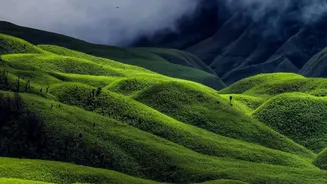
Straddling the border of Nagaland and Manipur, the rolling meadows of Dzukou Valley are as rich in stories as they are in flowers. One legend says it was named Dzukou, meaning 'soulless', by Angami ancestors who found the beautiful land too cold and barren for cultivation. Other tales speak of spirits inhabiting the valley. One poignant local story tells of two lovers from warring tribes who fled to the valley, only to be separated and lost forever in its thick mist, their whispers supposedly still heard on the wind.
Vindhya Range, Central India: The Humbled Giant
One of India's oldest mountain systems, the Vindhya Range was once, according to myth, so proud that it grew continuously, blocking the path of the sun, moon, and seasons. To restore balance, the revered sage Agastya travelled south and demanded passage. The mountain bowed in respect, and Agastya made it promise not to grow again until he returned. The sage settled in the south and never came back, leaving the Vindhyas forever humbled and a passage for all of life to cross.