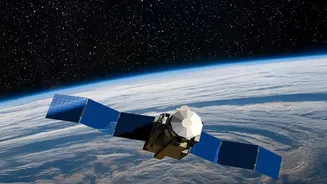








An Advanced Eye on Earth
The Earth Observation Satellite-05 (EOS-05) represents the latest generation in a long line of remote sensing satellites launched by the Indian Space Research Organisation (ISRO). At its core, an Earth observation satellite does exactly what its name
suggests: it observes our planet from orbit. These spacecraft are equipped with powerful sensors and cameras that capture detailed images of the Earth's surface. EOS-05 is designed to be a state-of-the-art asset, placed in a geosynchronous orbit (GEO) approximately 36,000 kilometres above the Earth. Unlike satellites in Low Earth Orbit (LEO) that circle the planet multiple times a day, a GEO satellite remains stationary over a specific region. This allows EOS-05 to provide near-continuous monitoring of the Indian subcontinent, a capability that is invaluable for a wide range of applications.
Dual-Purpose Technology
The true significance of the EOS-05 mission lies in its versatile, dual-use capabilities that serve both civilian and strategic needs. For civilian purposes, the satellite's advanced imaging systems are a game-changer for disaster management. It can provide real-time imagery of cyclones, floods, and forest fires, allowing authorities to respond more effectively and mitigate damage. In agriculture, its data helps in crop acreage estimation, monitoring crop health, and providing vital information for water resource management. Urban planners also benefit from this technology, using the high-resolution data to monitor urban sprawl, plan infrastructure development, and manage natural resources efficiently.
Strengthening National Security
Beyond its civilian applications, EOS-05 is a crucial asset for India's national security. Described as a "strategic satellite," its persistent gaze strengthens the country's surveillance capabilities along its vast land and maritime borders. The ability to continuously monitor areas of interest without interruption provides a significant tactical advantage. In an era where geopolitical situations can evolve rapidly, having an unwavering eye in the sky enhances situational awareness and aids in strategic decision-making. This mission builds upon the legacy of ISRO's earlier specialized satellites, such as the RISAT series, which provided all-weather and day-and-night observation, by adding the element of constant, high-frequency monitoring from a fixed position.
A Key Piece in ISRO's Vision
The EOS programme is a cornerstone of ISRO's broader mission to harness space technology for national development. Since the launch of the first Indian Remote Sensing (IRS) satellite in 1988, the programme has evolved dramatically, creating one of the largest constellations of remote sensing satellites in the world. These missions provide the essential data that underpins much of India's economic and developmental planning. The development and launch of sophisticated satellites like EOS-05 also drive technological innovation within the country, fostering a robust ecosystem of public and private players. As ISRO delegates more routine manufacturing to private industry, it can focus its resources on advanced research, next-generation technologies, and ambitious future projects.