







A Heart of Active Ice
Pluto's most famous feature is Tombaugh Regio, a bright, heart-shaped plain. The western lobe of this heart is a vast basin called Sputnik Planitia, a sprawling glacier made primarily of frozen nitrogen. This isn't a static sheet of ice; it's a dynamic,
churning landscape. The glacier is larger than Texas and Oklahoma combined and shows clear evidence of geological activity. Its surface is divided into city-sized polygonal cells, which are created by slow convection, similar to a lava lamp. Warmer, less dense nitrogen ice from the bottom slowly rises, while cooler, denser ice from the surface sinks. This constant resurfacing explains why the area has almost no impact craters—any pockmarks from space debris are erased over time. This process alone points to a world that is far from inactive.
The Liquid Nitrogen Theory
The latest surprise comes from a new analysis of high-resolution images taken by NASA’s New Horizons spacecraft during its 2015 flyby. Scientists noticed dark, linear streaks and diffuse patches along the northern edge of Sputnik Planitia. These features look strikingly similar to patterns on Earth's glaciers, which are wetted by meltwater or rain. But on Pluto, where surface temperatures hover around minus 236 degrees Celsius, nitrogen rain is physically impossible. This led researchers to a compelling new hypothesis: the liquid is coming from below. Computer models show that deep beneath the kilometers-thick ice sheet, the intense pressure could be enough to melt the nitrogen ice at its base, creating pockets of liquid nitrogen. This liquid, being less dense than the solid ice above it, could then be forced upward through cracks and fissures.
Clues on the Icy Surface
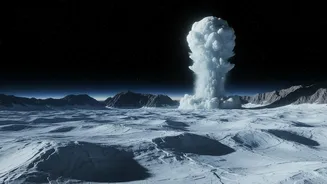
According to the study, led by New Horizons principal investigator Alan Stern, this subsurface liquid nitrogen could periodically reach the surface. Once there, it would briefly flow across the frozen plain before refreezing, darkening the ice and creating the distinct patterns captured by the spacecraft. This makes Sputnik Planitia not just a glacier, but potentially the site of recent or even ongoing cryovolcanism—a type of icy volcanic activity. “Pluto never stops surprising us,” Stern said, noting that the findings suggest a new kind of time-variable feature on the dwarf planet. This would be the first evidence of recently flowing liquid on Pluto’s surface, a landmark discovery that reshapes our understanding of the distant world.
A Dynamic World After All
This theory adds to a growing body of evidence that Pluto is a geologically dynamic world. For years, scientists have debated how Pluto has maintained its nitrogen-rich atmosphere, given that hundreds of tons of it escape into space every hour. The idea that geologic processes like cryovolcanism could be replenishing it from the interior has been a leading theory. The potential discovery of liquid flows offers strong support for this idea. Furthermore, other features like potential ice volcanoes and massive landslides have also been identified, painting a picture of a complex and evolving landscape. It suggests that even in the frigid outer reaches of the solar system, worlds can retain enough internal heat or generate it through other means to power active geology. Understanding these processes on Pluto could provide crucial insights into other icy bodies, like Neptune's moon Triton or the dwarf planet Eris.