


What Makes September a Unique Month?
September is a month of astronomical change. The most significant event is the autumnal equinox, which occurs this year on September 22 or 23, depending on your time zone. This marks the official start of autumn in the Northern Hemisphere. Astronomically,
the equinox is the moment the Sun crosses the celestial equator, and for a brief period, day and night are nearly equal in length across the globe. This seasonal shift means the familiar constellations of summer are beginning to set earlier, making way for the stars of autumn. The nights are growing longer, providing more time for stargazing. For astrophotographers, the dark, moonless nights around the New Moon on September 10-11 offer an excellent window to capture deep-sky objects like the Andromeda Galaxy as it climbs higher in the evening sky.
Which Planets Are on Display?
September 2026 is a fantastic month for planet-watching, with several bright worlds visible. Venus is a standout, appearing as a brilliant point of light low in the western sky shortly after sunset. It reaches its peak brightness for this evening appearance around September 18. You can also catch some beautiful pairings, such as the crescent Moon passing close to a bright Venus on September 14. Saturn rises in the evening and is visible for much of the night, with the full Moon passing near it on September 27. Mars and Jupiter are morning objects, rising after midnight. The waning Moon makes close approaches to Mars on September 6 and Jupiter on September 8. Neptune, the solar system's most distant planet, reaches opposition on September 26. This means it is opposite the Sun in our sky and at its brightest for the year. While you'll need binoculars or a telescope to spot its faint, blueish disk, it's the best opportunity of the year to find this elusive giant.
Are There Any Good Meteor Showers?
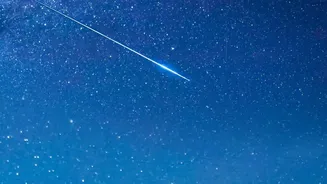
While September doesn't host a major meteor shower on the scale of the August Perseids, there are a couple of minor showers worth knowing about. The September Epsilon Perseids are expected to peak on the night of September 9. This shower typically produces only about five to eight meteors per hour, but this year's peak has a major advantage: it occurs just before the New Moon. This means the skies will be exceptionally dark, making it easier to spot the faint, fast-moving meteors. There's also the Aurigid meteor shower at the very beginning of the month, peaking on September 1, though a bright Moon will wash out fainter meteors. A weaker shower, the September Lyncids, peaks around September 13 under favorable moonless conditions but may only produce a few meteors per hour.
What Is the Harvest Moon?
The full Moon on September 26 is this year's Harvest Moon. This title is given to the full Moon that falls closest to the autumnal equinox. What makes it special is a unique effect seen in the Northern Hemisphere: for several evenings in a row around its peak, the Moon rises only about 25 to 30 minutes later each night, compared to the usual 50-minute delay. This phenomenon provides an extended period of bright moonlight in the early evening. Historically, this extra light was invaluable to farmers, allowing them to continue harvesting their crops after sunset. On the night of the full Moon, look for the planet Saturn shining nearby.
Key Constellations and What to Look For
As the Summer Triangle begins to shift westward, new patterns emerge. The great square of Pegasus becomes a prominent marker in the eastern sky, heralding the arrival of autumn constellations. Just off Pegasus, you can find the constellation Andromeda, home to the magnificent Andromeda Galaxy (M31). In the northern sky, look for the distinctive 'W' shape of Cassiopeia, which is now climbing higher and is easy to spot. Another charming and easily recognizable constellation this month is Delphinus, the Dolphin, which appears as a small, compact diamond shape leaping in the celestial sea. For those with binoculars and dark skies, the nights around the New Moon provide a chance to hunt for fainter objects like the Triangulum Galaxy (M33). The Moon can also act as a guide; from September 14 to 20, you can follow it as it passes the reddish star Antares in Scorpius and the Teapot asterism in Sagittarius.