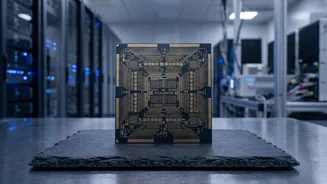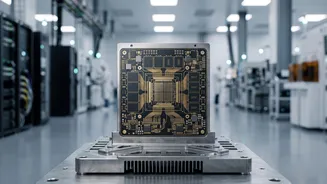









The immense power of modern artificial intelligence comes at a cost: massive energy consumption. Now, a new direction in hardware research using light-based processing aims to solve this, promising to make AI faster, cheaper, and more sustainable.
What is Light-Based AI Processing?
At its
core, light-based or 'photonic' computing swaps electrons for photons—particles of light—to perform calculations. For decades, computers have run on electronics, pushing electrons through silicon chips. This new approach uses tiny, on-chip optical components like waveguides and lenses to process data encoded in light waves. The fundamental operations that power AI, such as matrix multiplication, can be performed almost instantaneously as light passes through these optical circuits. This represents a fundamental shift from sequential electronic calculations to massively parallel optical ones, where multiple computations happen simultaneously.
The Soaring Demands of Modern AI
Today's large language models and other advanced AI systems require enormous computational resources for both training and inference. This has led to a surge in the energy consumption of data centers, which now face bottlenecks related to power, heat, and data transfer speeds. Traditional copper-based interconnects are hitting their physical limits, making it increasingly difficult and expensive to move the vast amounts of data that AI workloads demand. As AI models continue to grow, experts warn that these energy and data transfer constraints could become a major barrier to future progress.
The Advantages of Processing with Photons
Using light to compute offers several key advantages. First is speed and bandwidth; photons travel at the speed of light and can carry far more data than electrical signals. Second is energy efficiency. Because photons don't have electrical resistance, they generate significantly less heat, drastically cutting down on both power consumption and the need for expensive cooling systems in data centers. Finally, photonics allows for massive parallelism through a technique called wavelength-division multiplexing, where different colours of light can perform separate calculations at the same time within a single chip. This allows for a huge volume of operations to be completed in a fraction of the time it would take an electronic processor.
The Latest Research Breakthroughs
The field is moving from theory to practice with tangible new hardware. In late 2026, German company Q.ANT demonstrated a photonic processor that can perform discrete Fourier transforms—a key mathematical function in AI—directly with light. Their NPU Gen 2+ chip, built on thin-film lithium niobate, was shown working as a co-processor with a traditional GPU to accelerate a large language model. This hybrid approach, where optical chips handle specific, intensive tasks, is seen as the most viable path forward. Other recent work from universities includes new methods for training optical hardware more efficiently and creating hybrid light-matter 'quasiparticles' that combine light's speed with matter's ability to interact.
Hurdles on the Path to a Photonic Future
Despite the promise, significant challenges remain before photonic processors become mainstream. Manufacturing these chips requires extreme precision, with tolerances measured in nanometers, making high-yield production difficult and expensive. Integrating these novel optical components with existing electronic systems is a major technical hurdle, as they operate on fundamentally different principles. Developing the software and algorithms that can fully exploit the unique capabilities of photonic hardware is another critical area of ongoing research. Finally, testing and ensuring the reliability of these hybrid chips is a complex task requiring expertise in both electronics and optics.