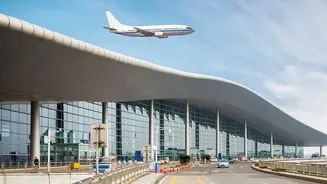









A Statewide Aviation Overhaul
Madhya Pradesh is in the midst of a significant aviation infrastructure push, with a clear strategy to enhance connectivity beyond its major hubs of Indore and Bhopal. The plan involves a multi-pronged approach: upgrading existing airports, building new
terminals, and converting smaller airstrips into fully functional airports. Recently, new terminal buildings have become operational in Gwalior and Jabalpur, drastically increasing their passenger handling capacity. The newly constructed Rewa Airport, inaugurated in late 2024, has brought the Vindhya region onto the national aviation map. Further, the state has identified ten existing airstrips for conversion into airports in phases. The first phase targets Singrauli, Sagar, Neemuch, Chhindwara, and Mandla, with Singrauli being a top priority due to its remote location. Additionally, new airports are under construction in Ujjain and Shivpuri, with a target to have ten operational airports in the state within the next two years.
The UDAN Effect: Connecting the Heartland
This ambitious expansion is deeply intertwined with the central government's UDAN (Ude Desh ka Aam Nagrik) scheme, a regional connectivity program designed to make flying affordable and accessible to the masses. The UDAN scheme provides Viability Gap Funding (VGF) to airlines to encourage them to operate on routes connecting unserved and underserved airports. Madhya Pradesh has leveraged this policy effectively, with the Union Aviation Minister praising the state's aviation policy as one of the best in the country. The upgrades at Rewa, Guna, Shivpuri, and the ten airstrips are all being carried out under the UDAN framework. In August 2026, four new routes were launched connecting Bhopal, Rewa, and Jabalpur with cities like Patna and Kolkata, further strengthening intra-state and inter-state links. The state government is also providing its own subsidies to support these new routes, underscoring its commitment to the plan.
More Than Just Runways and Terminals
The focus on smaller cities is a strategic move to unlock regional economic potential. For decades, residents of towns like Rewa or in the Mahakaushal region depended on long and arduous road or rail journeys to reach a major airport. Improved air connectivity changes this dynamic fundamentally. It opens doors for tourism, trade, and industrial growth by making these regions more accessible. The new airport in Ujjain, for example, is being fast-tracked ahead of the Simhastha festival in 2028, which is expected to attract millions of pilgrims. Similarly, the upgraded Jabalpur airport serves as a gateway to major tourist attractions like Kanha and Bandhavgarh National Parks. By connecting industrial and pilgrimage hubs, the state aims to create a more integrated and dynamic economy, generating employment and stimulating local businesses.
Spotlight on Key Upgrades
The scale of transformation is best seen in the individual projects. The new terminal at Gwalior, inaugurated in March 2024, was built in a record 16 months and increased passenger capacity to 1,400 per hour. It is an eco-friendly building featuring a large solar plant and rainwater harvesting systems. In Jabalpur, a new terminal building was commissioned in March 2024 as part of a Rs 412 crore upgrade, increasing peak hour capacity to 800 passengers and extending the runway to accommodate larger aircraft like the Airbus A320. Rewa Airport, once a small government airstrip, now accommodates 72-seater aircraft, connecting the Vindhya region directly to cities like Bhopal. These modern facilities are not just functional but also designed to reflect local culture, with terminals featuring Gond paintings and local handicrafts.
The Road Ahead
While the progress is substantial, the plan is far from complete. The development of ten new airports from existing airstrips is a long-term project requiring significant coordination for land acquisition, environmental clearances, and technical surveys. The new airport at Ujjain, for instance, has a deadline of October 2026 to secure environmental approvals. The success of these new airports will also depend on airlines sustaining operations on these regional routes, supported by government policies and passenger demand. The extension of the UDAN scheme until 2036 provides a stable policy environment for this growth. As Madhya Pradesh continues to build out its aviation network, it is creating a blueprint for how infrastructure investment can drive balanced regional development and bring the benefits of economic growth to all corners of the state.