


The Universe's Biggest Mysteries
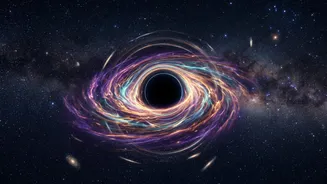
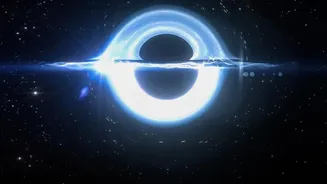
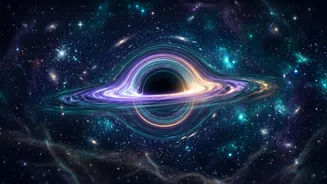
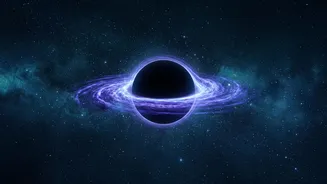
At the heart of nearly every large galaxy, including our own Milky Way, lurks a supermassive black hole (SMBH). These are objects of unimaginable density and gravity, weighing millions or even billions of times more than our Sun. A major puzzle for astronomers
is how they got so massive, so quickly, in the early universe. One of the leading ideas is that they grew from smaller 'seeds', but the exact nature of these seeds is debated. Did they come from the collapse of the first massive stars, or from the direct collapse of enormous gas clouds? Tangled up in this mystery is another, even bigger one: dark matter. This invisible substance makes up about 85% of the matter in the universe, and its gravity is the scaffolding upon which galaxies are built. One theory suggests that the seeds of giant black holes could be 'primordial black holes' that formed moments after the Big Bang, which themselves could be a component of dark matter.
A Message from the Dawn of Time
To test these theories, scientists need a way to map the distribution of all matter—both visible and dark—in and around distant galaxies. For this, they turn to the most ancient light in the cosmos: the Cosmic Microwave Background (CMB). This light is the afterglow of the Big Bang itself, released when the universe was just 380,000 years old. It fills the entire sky, providing a snapshot of the infant universe. Initially a hot, uniform plasma, tiny fluctuations in temperature within the CMB have since grown into the vast cosmic structures we see today, like galaxies and galaxy clusters. This ancient light has travelled across space for over 13 billion years to reach us, and on its journey, it carries clues about the structures it has passed.
How Light Bends Through Space
According to Einstein's theory of general relativity, massive objects warp the fabric of spacetime. As light travels past a massive object, its path is bent. This phenomenon is called gravitational lensing. You can think of it like looking through the distorted base of a wine glass; the image of what’s behind it is warped. In cosmology, massive galaxies and, crucially, their surrounding halos of dark matter act as cosmic lenses. As the ancient light from the CMB travels past these massive structures, it gets slightly bent and distorted. These tiny distortions change the apparent size and shape of the hot and cold spots in the CMB's temperature pattern. By carefully measuring these subtle changes, astronomers can create a map of all the mass—including dark matter—that the light has passed through.
The Test for Cosmic Giants
This is where the 'test' comes in. Scientists can now use telescopes like the Atacama Cosmology Telescope to create detailed maps of this CMB lensing. They can then point these maps at known distant galaxies that host supermassive black holes. By stacking the lensing signals from thousands of these galaxies, they can build a precise profile of how mass is distributed around them. This observed mass profile can then be compared to the predictions made by different theories of black hole formation. For example, if supermassive black holes grew from primordial black hole seeds that are also a form of dark matter, this would create a specific 'grainy' or clumpy mass distribution on large scales that would be reflected in the lensing data. If the observed mass distribution matches the predictions of one model but not another, it provides powerful evidence to solve the mystery of their origins.
Unlocking Galactic Secrets
The results of this cosmic test have profound implications. Confirming that supermassive black holes grew from massive seeds, such as those formed by direct-collapse gas clouds or from primordial black holes, would help explain how they reached such enormous sizes so early in the universe's history. It could also shed light on the very nature of dark matter itself. Discoveries made with the James Webb Space Telescope are continuously revealing surprisingly massive black holes in the very early universe, making these formation theories more important than ever to verify. This technique of using the oldest light to probe the structure of galaxies provides a completely independent way to test our understanding of how galaxies form and evolve, complementing other observations. By comparing computer simulations with what we see through gravitational lenses, scientists can refine our entire model of the cosmos.