




Our Protective Cosmic Bubble
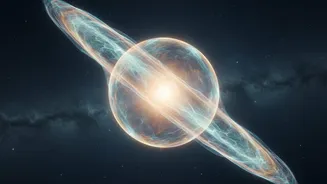
Imagine a shield that surrounds all the planets, protecting us from the harsh radiation of deep space. That shield is real, and it’s called the heliosphere. It’s a vast bubble created by the solar wind, a constant stream of charged particles flowing from the Sun.
This bubble extends far beyond Pluto, pushing back against the material between the stars, known as the interstellar medium. Without the heliosphere, galactic cosmic rays would bombard Earth, making life as we know it potentially impossible. It is our solar system’s first and most important line of defense against the rest of the galaxy.
Meet NASA's Cosmic Cartographer
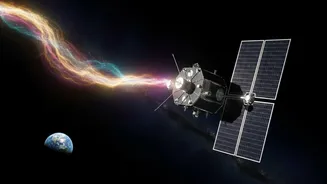
Enter NASA's Interstellar Mapping and Acceleration Probe, or IMAP. Launched in September 2025, this advanced spacecraft is a modern-day celestial cartographer. Its primary mission is to create the first comprehensive maps of the heliosphere's boundaries. Positioned at a strategic point a million miles from Earth towards the Sun, IMAP uses a suite of ten instruments to 'see' what’s happening at the edge of our solar system. By detecting particles like energetic neutral atoms (ENAs) that travel inward from this boundary, IMAP can build a picture of this distant, invisible frontier.
What the First Data Reveals
The recent release of scientific data from seven of IMAP's ten instruments is a major milestone for the mission. This initial dataset, gathered in the first few months of its operational phase, provides the first taste of the discoveries to come. Instruments are measuring the composition of the solar wind, tracking interstellar dust, and sensing the magnetic fields that govern this complex region. While the data from the key neutral atom imagers is still being calibrated, the information from instruments like the magnetometer and various particle detectors is already giving scientists a high-resolution look at the space environment and how particles are accelerated and filtered by our heliosphere.
Beyond the Voyager Probes
The legendary Voyager 1 and Voyager 2 spacecraft gave humanity its first direct contact with interstellar space by physically crossing the heliosphere's boundary. They provided invaluable but limited data points, like two ships dipping a thermometer in the ocean. IMAP, by contrast, is designed to observe the entire ocean at once from a distance. It builds on the legacy of previous missions like the Interstellar Boundary Explorer (IBEX) but with far more advanced instruments that can collect data across a wider range of energies and with greater precision, turning IBEX's blurry map into a high-definition movie.
Why This Cosmic Boundary Matters
Understanding the heliosphere isn't just an academic exercise. A clearer picture of this boundary helps us understand our place in the universe and what makes a solar system habitable. On a more practical level, IMAP's observations are crucial for improving space weather forecasting. By providing a real-time stream of data on incoming solar particles, IMAP can give about a 30-minute warning for potentially hazardous radiation events. This is critical for protecting satellites in orbit and, most importantly, astronauts on future deep-space missions like the Artemis program to the Moon and eventual journeys to Mars.