


A Cosmic Crime Scene
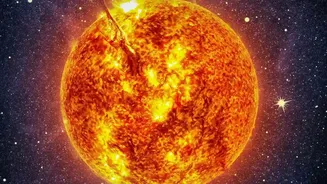
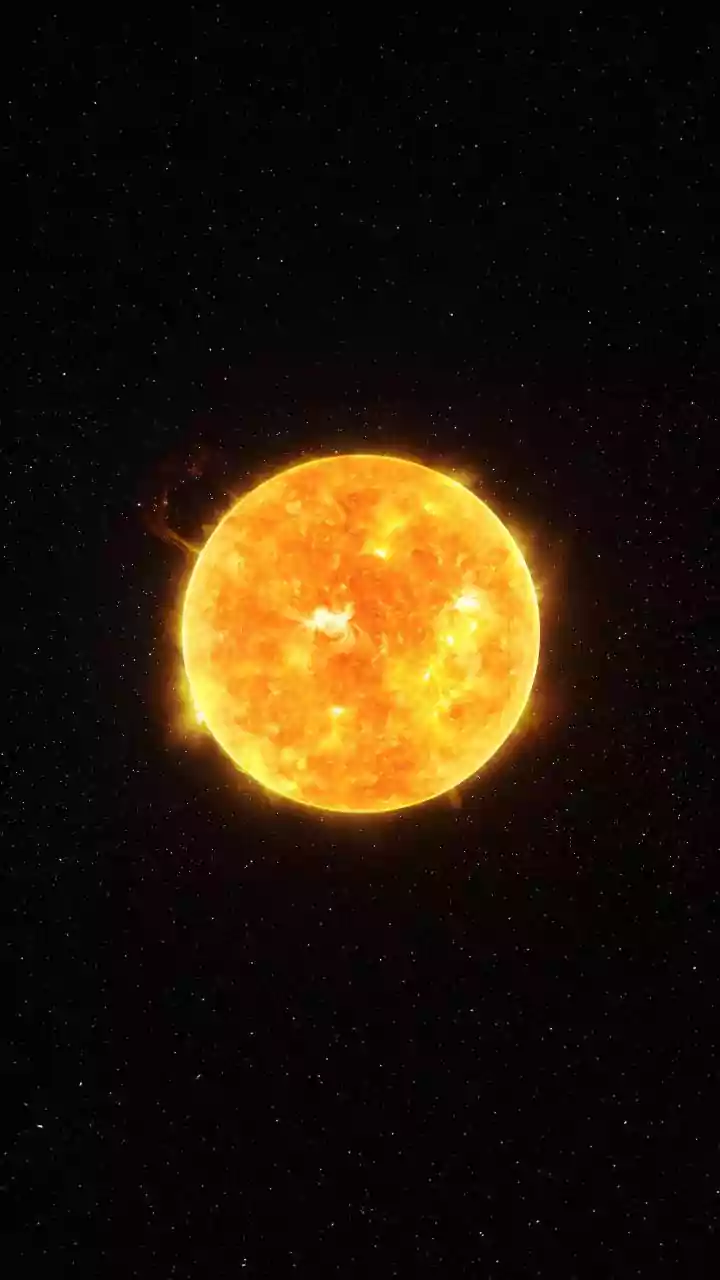
A recent study published in the Monthly Notices of the Royal Astronomical Society suggests our Sun may be a cosmic cannibal. A team of astronomers, led by Professor Mutlu Yildiz of Ege University in Turkey, has put forward a compelling, if unproven, theory.
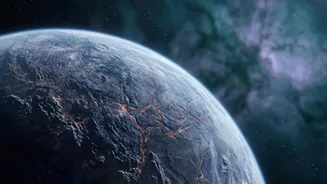
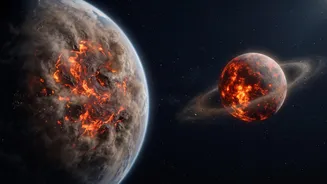
Their models indicate that a “super-Earth”—a rocky planet between five and ten times the mass of our own world—could have spiralled into the Sun during the chaotic early days of the solar system. This dramatic event, they argue, wouldn't have been erased by time. Instead, it would have left a permanent chemical signature inside the star, potentially explaining several mysteries that have puzzled solar physicists for decades.
The Chemical Fingerprints
So, what are these long-standing mysteries? For one, the Sun’s surface has a surprisingly low amount of the element lithium. Lithium is easily destroyed at the high temperatures found inside stars, so its abundance acts as a historical record. Standard models of the Sun’s evolution predict it should have more lithium than it does. Furthermore, there are subtle but persistent mismatches between the Sun's observed internal structure—studied through a field called helioseismology, which analyses sound waves travelling through the star—and what the models predict. The research team ran complex simulations and found that the ingestion of a rocky super-Earth could neatly resolve these discrepancies, accounting for both the missing lithium and the structural anomalies.
What is a Super-Earth?
The term “super-Earth” might sound like a bigger, better version of our home, but it simply refers to a planet's mass and size. These are exoplanets more massive than Earth but significantly lighter than our system’s ice giants, Uranus and Neptune. They can be rocky, gaseous, or a combination of both. What makes them particularly relevant to this theory is that they are incredibly common throughout the galaxy, found orbiting a large percentage of stars similar to our Sun. This has made their complete absence in our own solar system a puzzle. This new theory provides a potential, albeit destructive, explanation: perhaps our solar system did have a super-Earth, but it was one of the first planets to form and got a little too close to our young star.
A Chaotic Youth
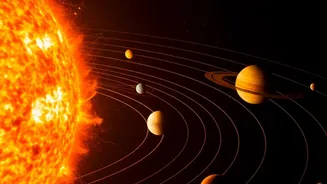
It’s hard to imagine, but our solar system wasn’t always the orderly place it is today. In its first few hundred million years, it was a cosmic demolition derby. Planets and countless smaller bodies called planetesimals were forming, and their orbits were often unstable. Planetary migration—the process where planets shift their orbits significantly over time—was common. Giant planets like Jupiter and Saturn moved around, scattering smaller objects and creating a chaotic environment where collisions were frequent. In such a system, it is entirely plausible that a newly formed planet’s orbit could have been destabilised, sending it on a collision course with the Sun.
A Theory Awaiting Proof
It is crucial to remember that this fascinating idea is still a theory based on computer modelling. It doesn't definitively prove the Sun swallowed a planet. However, it provides a testable hypothesis. The researchers believe that the specific chemical and structural signatures predicted by their models could potentially be detected with future, more precise observations using helioseismology. If these “fingerprints” can be found, it would provide powerful evidence for this ancient act of planetary consumption. It would not only solve some of the Sun’s most persistent puzzles but also rewrite our understanding of our own solar system’s infancy, suggesting that it was once home to a planet that we never knew was lost.