


1. Governor’s House (Raj Bhavan)
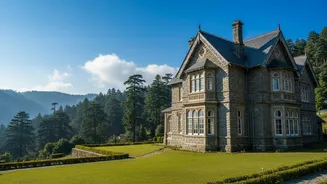
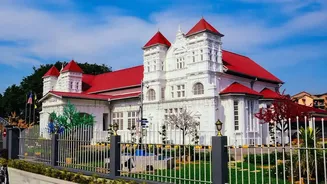
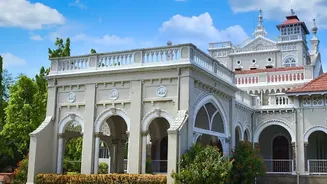
A symbol of peak colonial power, the Governor's House, now Raj Bhavan, served as the summer residence for the Governor of the United Provinces. Its construction began in 1897, and the magnificent two-storied structure with 113 rooms was designed in a Victorian
Gothic style, reminiscent of a Scottish castle. Designed by F.W. Stevens, it sits on a sprawling 220-acre estate, which even includes a 45-acre golf course. This building was the administrative and social heart of the British summer capital, embodying the grand lifestyle of the colonial elite. Sarojini Naidu was its first Indian occupant after Independence.
2. St. John in the Wilderness Church
One of the earliest structures in Nainital, this church tells the story of the town's founding. Established in 1844, it was named by the Bishop of Calcutta, Daniel Wilson, who had to stay in an unfinished hut in the forest during his visit to lay the foundation stone. This experience led to its evocative name. Built in the Neo-Gothic style amidst a dense deodar forest, the church is a serene spiritual retreat. It also holds a significant memorial: a brass plaque bearing the names of the victims of the devastating 1880 landslide, a pivotal event in Nainital's history.
3. The Old Secretariat (Uttarakhand High Court)
What now serves as the majestic seat of the Uttarakhand High Court was originally the Secretariat for the United Provinces government. Constructed in 1900, this building was the engine room of the British administration during their summer sojourn in the hills. Its creation solidified Nainital's status as a functional capital, not just a resort town. Designed by Santoni MacDonald in a classic Gothic style, its location in Mallital was central to the town's administrative life. Today, it continues its legacy as a centre of governance.
4. Gurney House
This charming cottage on Ayarpatta Hill offers a more personal glimpse into colonial life through its most famous resident, Jim Corbett. Built in 1881, Gurney House was the home of the legendary hunter-naturalist and his sister Maggie until they left for Kenya in 1947. The house was constructed using materials from their previous home on Alma Hill, which was destroyed in a landslide. It preserves the atmosphere of the era, still housing much of Corbett's original furniture and possessions. It represents the life of British residents beyond the officialdom of government buildings.
5. The Nainital Club
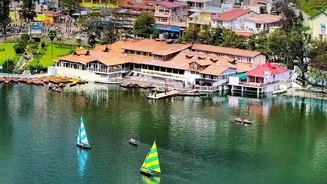
Clubs were central to the social life of the British in India, and The Nainital Club was among the most exclusive. It was the hub of social and sporting activities for the colonial elite. The club was particularly famous for yachting, being the only one in India at the time to offer inland sailing on Naini Lake. Initially having an exclusive British membership, it was a space where the ruling class could recreate a slice of England in the Himalayas. The club and its associated Boat House were integral to the leisurely, privileged lifestyle that defined the hill station.
6. Methodist Church
Established in 1858, this was the first Methodist church in India and holds a significant place in the history of missionary work in the country. Its construction was initiated by Rev. William Butler, who was sent to India to start the Methodist mission. The establishment of schools and churches was a key part of the colonial project, aimed at education and cultural influence. This Gothic-style church on the Mallital road became a landmark, reflecting the religious and educational expansion that accompanied the administrative growth of the town.
7. St. Joseph’s College
The establishment of elite educational institutions was a priority for the British to educate the children of their officials and soldiers. St. Joseph's College, founded in 1888 by Irish brothers, is a prime example. Like many other European-style schools founded in the latter half of the 19th century, it was designed to provide a British standard of education in the healthier climate of the hills. These schools turned Nainital into a major educational hub, a legacy that continues to this day and demonstrates how the town was developed to support a permanent community, not just transient visitors.