


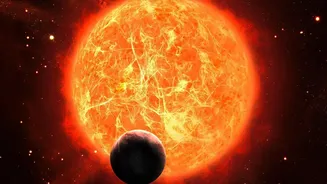

A Signal From a Scorching World
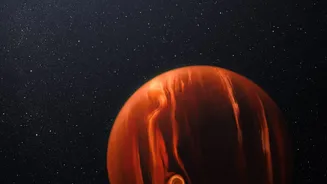
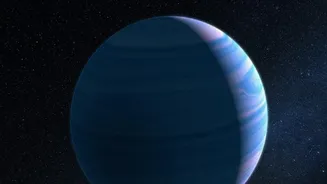
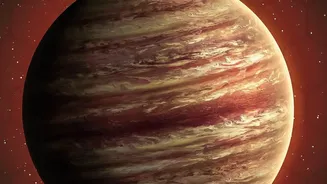
In a remarkable display of its power, NASA’s James Webb Space Telescope (JWST) has detected the distinct signature of water vapor in the atmosphere of a massive exoplanet known as WASP-18 b. This isn't a temperate, Earth-like world; it's an 'ultra-hot
Jupiter,' a gas giant ten times more massive than our own Jupiter that orbits perilously close to its star. The planet is tidally locked, meaning one side permanently faces the star, experiencing blistering temperatures that can reach nearly 2,700 degrees Celsius. A year on this world is a blink-and-you'll-miss-it 23 hours long.
Reading an Alien Atmosphere
Detecting this signal was a feat of cosmic detective work. Scientists used a technique called transmission spectroscopy. As WASP-18 b passed in front of its host star, Webb's sensitive instruments analyzed the starlight that filtered through the planet's atmosphere. Different molecules absorb light at specific wavelengths, leaving behind a unique chemical 'fingerprint'. Even though the extreme heat on WASP-18 b is intense enough to break water molecules apart, Webb was sensitive enough to pick up the subtle, telltale signs of the water vapor that remained. This precise measurement, which had been difficult with previous telescopes, confirms the extraordinary capability of JWST.
Meet Planet WASP-18 b
First discovered in 2009, WASP-18 b has long been a target of fascination for astronomers. Located 400 light-years away, it belongs to a class of planets with no equivalent in our solar system. These 'hot Jupiters' are gas giants that orbit their stars at extreme proximity. WASP-18 b circles its star at a distance of just 3.1 million kilometers, a tiny fraction of the distance between our Sun and its innermost planet, Mercury. In addition to detecting water, the Webb observations allowed scientists to create a temperature map of the planet's day side, revealing a massive temperature drop of up to 1,000 degrees from the point directly facing the star to the 'terminator' line where day meets night.
Why This Discovery Matters
Finding water on a single, scorching-hot gas giant is about more than just one planet. This discovery is a powerful demonstration of the Webb telescope's ability to analyze exoplanet atmospheres in unprecedented detail. It proves that we now have the technology to detect key molecules—including potential biosignatures on other worlds—from hundreds of light-years away. By successfully identifying water here, under such harsh conditions, it strengthens the prospect of using the same techniques to study the atmospheres of smaller, rocky planets that might be more hospitable to life. Each discovery like this is a crucial stepping stone, moving us from simply finding planets to truly understanding them.
A New Era of Exploration
The James Webb Space Telescope is fundamentally changing our understanding of how planets form and evolve. By analyzing the chemical makeup of WASP-18 b's atmosphere, scientists can gather clues about its origins. Early analysis suggests the planet's composition is very similar to its star, meaning it likely formed from the gas left over just after the star itself was born. This kind of insight was previously out of reach. As Webb continues its mission, it will target a wide range of exoplanets, from gas giants to rocky super-Earths, each observation bringing us closer to answering the ultimate question: are we alone in the universe?