




Meet NASA's Next Great Observatory
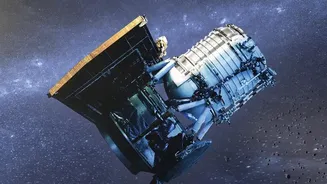
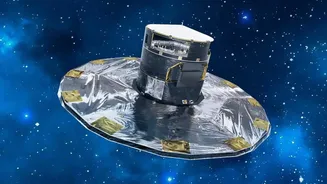
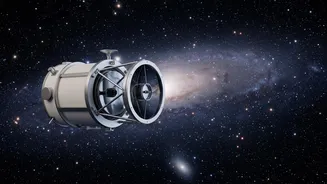
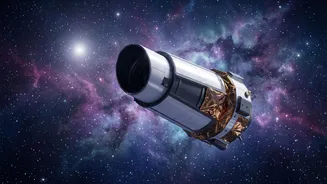
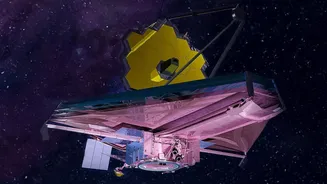
Following in the footsteps of giants like the Hubble and James Webb Space Telescopes, the Nancy Grace Roman Space Telescope is NASA's latest flagship mission designed to unravel the universe's deepest secrets. Named after Dr. Nancy Grace Roman, NASA's first
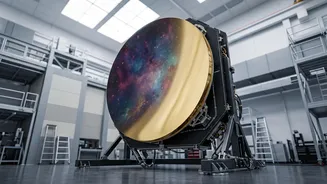
chief of astronomy and the “Mother of Hubble,” this observatory has a mirror the same size as Hubble's but boasts a field of view 100 times larger. Launched in late August 2026, the telescope is now on its way to its operational orbit about 1.5 million kilometers from Earth, a gravitationally stable spot known as Lagrange Point 2 (L2). Its primary goals are ambitious: to investigate the mysteries of dark energy and dark matter, discover thousands of new exoplanets, and create vast infrared maps of the sky.
A Universe in a Single Glance
The defining feature of the Roman telescope is its Wide Field Instrument (WFI), a 300-megapixel camera that gives it a panoramic perspective unlike any other space telescope. To put its power into perspective, where Hubble would need to take hundreds of individual images to map a large area of the sky, Roman can do it in just a handful. This incredible efficiency transforms the observatory from a precision tool for observing specific targets into a powerful survey machine. Instead of looking at the cosmos through a soda straw, Roman sees a vast landscape in every snapshot. This allows it to gather massive amounts of data quickly, creating deep, high-resolution images of millions of galaxies, potentially even billions over its five-year primary mission.
The Power of a Panoramic View
This wide-angle capability isn't just about taking bigger pictures; it's about a fundamental shift in strategy. With its sweeping surveys, Roman will create enormous cosmic maps that will help scientists understand the large-scale structure of the universe. One of its key missions is to probe the nature of dark energy, the mysterious force causing the universe's expansion to accelerate. By observing how galaxies are clustered and measuring their distances using exploding stars called supernovae, Roman will provide crucial data to test theories about this enigmatic force. Furthermore, its surveys will map the distribution of dark matter, the invisible scaffolding upon which galaxies are built, by observing how its gravity bends the light from distant galaxies.
Hunting for Thousands of New Worlds
Beyond cosmology, Roman is set to revolutionize the hunt for exoplanets—planets orbiting other stars. While missions like Kepler and TESS found planets by looking for the dip in starlight as a planet passes in front of its star, Roman will primarily use a technique called gravitational microlensing. This method detects planets by observing how their gravity, combined with their host star's, can magnify the light of a more distant, background star. Because this technique can find planets much farther from their star, Roman is expected to discover a huge diversity of new worlds, including those similar to the planets in our own solar system. Projections suggest Roman could find over 100,000 transiting and microlensing planets, dramatically expanding our catalogue of known worlds.
More Than Just a Wide-Angle Lens
While the Wide Field Instrument gets most of the attention, Roman also carries a groundbreaking technology demonstrator called the Coronagraph Instrument. A coronagraph is a device designed to block the overwhelming glare from a star, allowing astronomers to see the much fainter light of planets orbiting it. Roman's coronagraph is a major leap forward, capable of suppressing starlight 100 to 1,000 times better than previous instruments in space. This will enable it to directly image large, Jupiter-like planets for the first time. More importantly, it serves as a crucial stepping stone for future missions, like the planned Habitable Worlds Observatory, which will use similar technology to search for Earth-like planets and analyze their atmospheres for signs of life.