




What is PRIMA?
PRIMA, which stands for the PRobe far-Infrared Mission for Astrophysics, is a new space observatory designed to explore the universe's history. Unlike the James Webb Space Telescope (JWST), which primarily sees near- and mid-infrared light, PRIMA will
survey the cosmos in the far-infrared spectrum. This allows it to see things that other telescopes cannot, peering through cosmic dust to uncover secrets about how planets, stars, and galaxies form and evolve. It represents what NASA's Nicky Fox calls "humanity's next window into the deep universe." PRIMA is also the first mission in a new category called Probe Explorers, designed to be more cost-effective than flagship missions like the $10 billion JWST but more powerful than smaller efforts.
Demystifying 'Phase B'
When NASA says a project has entered Phase B, it means the mission is moving from early concepts into concrete design. This stage, officially known as 'Preliminary Design and Technology Completion,' is where engineers finalize technology, build prototypes, and establish a clear technical, cost, and schedule baseline for the entire project. It is a crucial step where the mission's preliminary designs are solidified, and the team must demonstrate that its plans are feasible and mature enough to proceed. Upon successful completion of Phase B, the mission undergoes a critical confirmation review. This review assesses all technical and financial progress before granting approval to move to Phase C, which involves final design and fabrication.
The Significance of the $1.2 Billion Cap
The $1.2 billion cost cap (which excludes launch expenses) is a defining feature of the PRIMA mission and the new Probe Explorer class it pioneers. This approach was recommended by the National Academies' 2020 Decadal Survey to create a pipeline of powerful, medium-sized missions that can be developed on a more predictable budget and schedule. By setting a firm financial limit early on, NASA aims to ensure fiscal discipline and avoid the massive budget overruns that have plagued some past flagship projects. This model allows the agency to pursue groundbreaking science while maintaining a steady cadence of missions. The selection of PRIMA was based not only on its scientific merit but also on the feasibility of its development plan within this cost and schedule framework.
The Science PRIMA Will Uncover
PRIMA's ability to see in far-infrared light will fill a critical gap between observatories like JWST and ground-based radio telescopes. Its primary goals are ambitious. Scientists hope to trace the origins of planets, including quantifying the role of water in their formation. The telescope will also investigate the co-evolution of galaxies and the supermassive black holes at their centers. Furthermore, PRIMA will study how cosmic dust and heavy elements have accumulated throughout the universe's history, helping to paint a complete picture of why the cosmos looks the way it does today. According to researchers, these are questions that JWST cannot answer because the necessary spectral lines are only visible in the far-infrared wavelengths PRIMA is designed to detect.
The Road to Launch
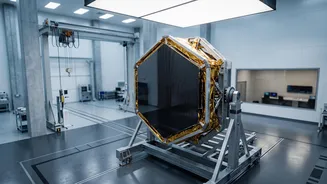
With its advancement to Phase B, the PRIMA team at NASA's Jet Propulsion Laboratory and its international partners will spend the next few years refining the observatory's design and technology. The mission will use a cryogenically cooled 5.9-foot (1.8-meter) telescope and a suite of advanced instruments to achieve its scientific objectives. After its confirmation review, the project will move into the final design, fabrication, and testing phases. If all goes according to plan, PRIMA is scheduled to launch no earlier than 2033 for a planned five-year mission, ready to provide astronomers with an unprecedented view of the cool universe.