


A Chaotic Cosmic Past
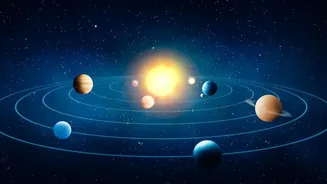
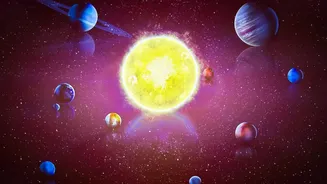
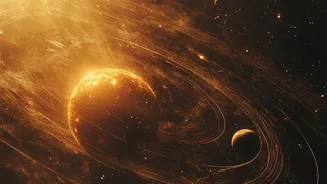
Forget the neat, clockwork model of the solar system you learned in school. Billions of years ago, our cosmic neighborhood was a violent, chaotic place. Giant planets roamed and migrated, flinging debris and smaller worlds around like cosmic billiard
balls. The orbits we see today are the calm aftermath of a turbulent youth. In this early scrum, planets formed, collided, and were sometimes ejected into deep space or destroyed. It’s within this chaotic origin story that scientists are now searching for answers to one of our solar system's most peculiar features: a missing class of planets.
The Super-Earth Mystery
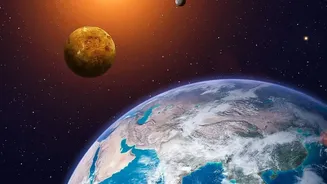
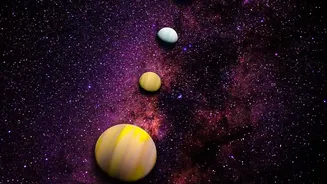
As astronomers have peered out into the galaxy, they’ve discovered that planets are incredibly common. One of the most frequent types they find is the “super-Earth”—worlds with a mass somewhere between Earth and Neptune. They appear so often around other stars that their complete absence in our own solar system is a genuine mystery. Why do we have small rocky worlds like Earth and Mars, and gas giants like Jupiter, but nothing in between? Did they never form? Or did they form, only to disappear? A new theory puts forward a dramatic answer: we had at least one, but the Sun ate it.
A Sacrificial Planet
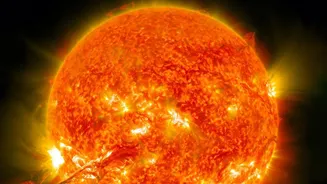
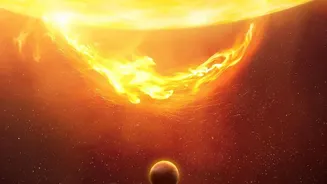
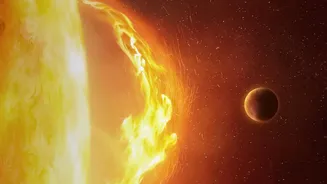
A recent study, published in the journal Monthly Notices of the Royal Astronomical Society, proposes that one or more super-Earths may have formed in the early solar system. According to computer models run by a team led by Professor Mutlu Yildiz of Ege University, gravitational interactions could have caused this planet to migrate inward, spiraling closer and closer until it was ultimately consumed by the infant Sun. This sacrificial act, the theory suggests, wouldn't just remove the planet; it would have left a lasting chemical fingerprint on the Sun itself, potentially explaining some long-standing solar anomalies. For instance, it could account for the Sun's surprisingly low surface levels of the element lithium and subtle discrepancies in its internal structure that standard models struggle to explain.
The All-Important Qualification
And now for the key qualification promised in the headline. As compelling as this sounds, it is crucial to remember that this is a conclusion based on computer modeling, not direct observation. Scientists did not see this happen; they ran simulations that showed if a planet were swallowed, it would produce a Sun that looks more like the one we have today. The theory provides an elegant solution to multiple puzzles, but it is not definitive proof. The 'evidence' is the model’s success in matching observations, but other explanations for the Sun's oddities might still exist. It’s a powerful hypothesis, but a hypothesis nonetheless, awaiting more evidence.
A Story of How We Got Here
So why does this matter? This research is about more than just a single lost world. It helps us reconstruct the story of our own existence. Theories like this, and others such as the “Grand Tack” hypothesis where Jupiter migrated inwards and then outwards, paint a picture of a dynamic and sometimes destructive process of planetary formation. Understanding whether our Sun devoured its own children could tell us whether our solar system's architecture is a normal outcome or a rare exception. It pushes the boundaries of what we can learn about the past by studying the present, using the Sun's own composition as a history book of events that unfolded billions of years ago.