








Inside the New Facilities
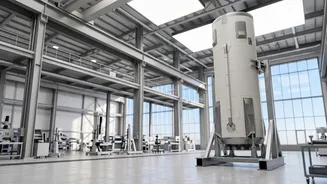
Agnikul recently inaugurated two key facilities at its Chennai assembly and testing site: the Stage Testing & Inspection Facility (STIF) and the Pressurant Tank Realisation, Over-wrapping and Outfitting Facility (PROOF). These aren't just new buildings;
they represent a major enhancement of India's private space infrastructure. STIF is designed to test complete rocket stages under the intense conditions they would experience during a flight. Crucially, it will also be used for post-flight inspection and requalification of recovered stages, a vital step in the reusable rocket lifecycle. The PROOF facility brings the production of high-pressure vessels—essential components that hold gases and liquids at extreme pressures—in-house, giving Agnikul greater control over its supply chain and accelerating production.
A Quick Look at Agnikul
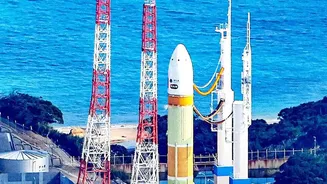
Founded in 2017 and incubated at IIT Madras, Agnikul Cosmos has rapidly become a leading name in India's burgeoning space-tech scene. The company made headlines on May 30, 2024, with the successful launch of its Agnibaan SOrTeD (SubOrbital Technological Demonstrator). This mission was a landmark achievement, marking India's first launch from a private launchpad, the first flight powered by a semi-cryogenic engine, and the world's first flight using a single-piece 3D-printed engine. This focus on innovative manufacturing, particularly 3D printing, allows Agnikul to produce complex engines like its Agnilet and Agnite models faster and more cost-effectively than traditional methods.
Why Reusability is a Game-Changer
For decades, rockets were single-use machines. The most expensive and complex parts would be discarded after just a few minutes of flight, falling into the ocean. This made space access incredibly expensive. Reusability, famously pioneered by companies like SpaceX, changes the economics entirely. By recovering and reflying the most valuable parts of a rocket, a company can dramatically lower the cost of launching satellites. This opens up space to more customers, enables more frequent launches, and makes ambitious projects like satellite mega-constellations feasible. Agnikul's investment in these new facilities shows a clear commitment to mastering this technology, which is seen as essential for competing in the modern global space market.
The Art of Requalification
So what does it mean to "requalify" a rocket stage? After a rocket booster is recovered from a mission, it can't simply be refueled and launched again. It must undergo a rigorous process of inspection and testing to prove it is fit for another flight. This is what qualification is all about: proving the hardware can withstand the incredible forces, vibrations, and temperatures of launch. Agnikul's new STIF facility is built specifically for this purpose. It allows engineers to test the recovered stage, check for any structural fatigue or damage, and certify that it meets the exact same safety and performance standards as a brand-new stage. Having this capability in-house is a massive advantage, streamlining the entire 'fly, recover, inspect, refly' cycle.
A Giant Leap for India's Space Economy
Agnikul's new facilities are more than just a win for one company; they are a significant development for the entire Indian space ecosystem. By building the only private infrastructure in India for post-flight requalification, Agnikul is positioning itself as a leader in the race for reusable launch vehicles. This development, celebrated by figures like Gaganyaan astronaut Group Captain Shubhanshu Shukla who inaugurated the facilities, reinforces India's push for self-reliance in space technology. As CEO Srinath Ravichandran noted, the vision of reusability requires building the capability to test, recover, inspect, and prepare a stage for its next flight. With these facilities, Agnikul is turning that vision into a tangible reality, preparing for future missions and strengthening India's standing in the multi-billion dollar global space industry.