





The Allure of Diamond Rain
For decades, planetary scientists have theorized about the extraordinary weather on our solar system's gas giants. Unlike the water rain on Earth, planets like Saturn and Jupiter might experience precipitation of a far more precious kind: diamonds. The
basic theory is that the conditions deep inside these colossal planets are perfect for transforming simple carbon into one of the universe's hardest materials. Saturn's atmosphere contains methane, a molecule made of carbon and hydrogen. Powerful lightning storms, far more intense than any on Earth, are thought to break these methane molecules apart. This process releases carbon atoms, which then clump together to form particles of soot. As this soot falls deeper into the planet, it encounters steadily increasing pressure and temperature. It is this incredible compression that scientists believe could squeeze the soot first into graphite, and then, much deeper down, into solid diamonds.
From Theory to a Tangible Model
While the idea of diamond rain has been around for a while, it remained largely a hypothesis. The main challenge was proving that this process could actually happen under the chaotic and extreme conditions found thousands of kilometres below Saturn's clouds. Direct observation is impossible; no probe can survive the crushing pressures that would be required. Therefore, scientists have turned to laboratory experiments and sophisticated computer models to test the theory. Early models were promising but faced questions about whether carbon would remain separate long enough to form crystals, or whether it would simply mix with the dense hydrogen and helium that dominate Saturn's atmosphere. The theory gained significant traction with experiments at facilities like the SLAC National Accelerator Laboratory. In these tests, scientists used high-powered lasers to create shock waves in materials that mimic the composition of gas and ice giants, allowing them to recreate the immense pressures for fractions of a second.
Recreating an Alien Inferno on Earth
In a landmark experiment, scientists used a type of plastic called polystyrene—which contains both hydrogen and carbon—to simulate the chemical environment. By blasting the plastic with powerful optical lasers, they generated shock waves that compressed the material at pressures millions of times greater than Earth's atmosphere, and at temperatures exceeding 9,000 degrees Fahrenheit. Using ultra-fast X-ray pulses, they could observe what happened in real-time. To their surprise, they found that the carbon atoms in the plastic quickly separated and began forming tiny diamond structures, known as nanodiamonds. This confirmed that the transformation from carbon to diamond can happen incredibly fast, a key piece of the puzzle. More recent experiments have refined this understanding, showing that the presence of other elements, like oxygen (found in ice giants like Neptune and Uranus), can actually help accelerate the formation of diamonds, allowing them to form at lower pressures than previously thought.
A Journey to a Molten Diamond Sea
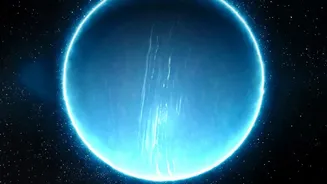
According to the current models for Saturn, this process could produce an astonishing amount of diamonds—with some estimates suggesting around 1,000 tonnes per year. These newly formed gems, potentially growing up to a centimetre in size, wouldn't stay put. Being much denser than the surrounding fluid, they would continue to sink deeper into the planet, a slow-motion hail storm lasting thousands of years. However, the journey for these diamonds has a dramatic end. As they fall another 30,000 kilometres or so, the pressure and temperature become so extreme that even diamonds cannot remain solid. Scientists theorize that they eventually melt, contributing to what could be a vast layer or ocean of liquid carbon deep in the planet's interior. This differs from the ice giants Uranus and Neptune, which are cooler, potentially allowing the diamonds to remain solid and accumulate in a thick layer around the core.
Why This Cosmic Alchemy Matters
Understanding diamond rain is more than just a fascinating cosmic curiosity. These models provide critical insights into the internal structure and evolution of giant planets. The process of diamonds forming and sinking would release gravitational energy, which generates heat. This could help explain why planets like Saturn radiate more heat than they receive from the Sun. Furthermore, the potential existence of vast diamond layers or liquid carbon oceans would significantly influence how heat is transported within the planet and could play a role in generating their powerful and unusual magnetic fields. For scientists on Earth, these experiments also open up new avenues for creating nanodiamonds, which have a wide range of applications in electronics, medical procedures, and quantum computing. By simulating the interiors of distant worlds, we are not only exploring the cosmos but also advancing technology here at home.