





A New Twist in Drone Warfare
The conflict in Ukraine has become a vast laboratory for drone warfare, defined by a constant cycle of innovation and adaptation. The latest development in this technological arms race is Russia's use of First-Person View (FPV) drones guided by fibre-optic
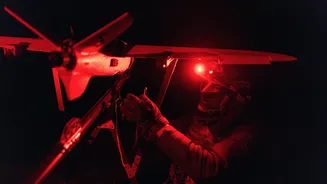
cables. These systems, which have been spotted on the front lines, represent a direct response to the pervasive signal jamming that characterises the modern battlefield. Unlike conventional FPV drones that rely on radio-frequency links for control and video transmission, these tethered drones are physically connected to their operator, making them almost completely immune to electronic interference. Both Russia and Ukraine have been developing and deploying this technology, with Russia reportedly being the first to field them. Models like Russia's 'Molniya' fixed-wing drone and other quadcopters have been adapted for this purpose.
How Fibre Optics Beat Jamming
The primary advantage of a fibre-optic connection is its invulnerability to electronic warfare (EW). Standard drones are susceptible to jamming systems that disrupt the radio signals between the drone and its pilot, causing a loss of control or video feed. By contrast, a fibre-optic cable transmits data as pulses of light, which cannot be jammed by radio-wave interference. This ensures a stable, high-quality video link and reliable control, even in areas saturated with EW systems. For pilots, this means they can guide the drone to its target with greater precision and confidence. The physical link also prevents the operator's position from being pinpointed through radio direction-finding, a common tactic used to target drone crews. This simple but effective workaround has forced a change in tactics, with some suggesting the only reliable way to stop these drones is to shoot them down with small arms.
The Catch: A Physical Leash
Despite their anti-jamming capabilities, fibre-optic drones come with significant limitations. The most obvious is the physical tether itself. The drone can only fly as far as the cable allows, which typically ranges from a few kilometres to around 20 km, though longer-range prototypes exist. This limits their operational reach compared to untethered drones. The weight of the spool of cable also reduces the drone's speed and the size of the explosive payload it can carry. Furthermore, the cable is fragile. It can snag on trees, buildings, or other obstacles, leading to the loss of the drone. In fact, forests in regions like Kharkiv are reportedly becoming entangled with thousands of kilometres of these discarded cables, creating an environmental hazard. These drawbacks mean that fibre-optic drones are not a universal solution but a specialised tool for specific scenarios, particularly for striking high-value targets in heavily defended areas where traditional drones would fail.
The Bigger Picture: An Electronic Arms Race
The deployment of fibre-optic drones is just one move in the relentless cat-and-mouse game of electronic warfare in Ukraine. From the early days of the conflict, both sides have invested heavily in EW systems to create 'kill zones' where enemy drones cannot operate. The introduction of a jam-proof drone by one side inevitably prompts the other to adapt. Ukraine, for instance, quickly developed its own fibre-optic prototypes after Russia's appeared on the battlefield. Just this week, a Ukrainian tech company unveiled a system that can control up to five fibre-optic FPV drones from a single station, incorporating AI for target recognition. This constant back-and-forth illustrates that there is no single 'super weapon' in this conflict. Instead, victory often goes to the side that can adapt its technology and tactics the fastest, integrating various systems—reconnaissance drones, strike drones, and EW platforms—into a cohesive network.