





A Monster Far From Home
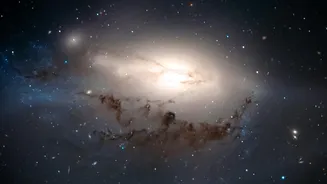
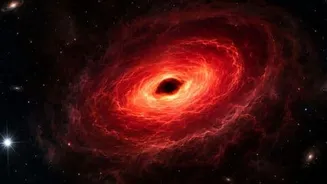
Astronomers expect to find supermassive black holes in the crowded, central cores of large galaxies like our own Milky Way. That’s why a recent discovery has caused such a stir. A black hole, weighing about a million times more than our sun, was caught
ripping a star to shreds on the distant outskirts of its galaxy. The event, known as a tidal disruption event (TDE), created a flare so bright it temporarily outshone its entire host galaxy in certain wavelengths of light. This wasn't just slightly off-the-mark; the black hole was lurking more than 30,000 light-years away from the galactic center. The discovery confirms what was once a theory: massive black holes can be wanderers, likely kicked out of their original homes by galactic mergers, and TDEs are the bright flares that reveal their hiding spots.
Cosmic Spaghettification
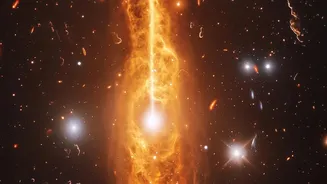
So what exactly happens when a star meets a black hole? The process is as violent as it sounds. When a star's orbit brings it too close to a black hole, the hole's immense gravitational pull on the near side of the star is much stronger than on the far side. This difference in force, or tidal force, stretches the star vertically while squeezing it horizontally, tearing it into a long, thin stream of gas. This process has been morbidly nicknamed 'spaghettification'. As this stellar material falls toward the black hole, it heats up and creates a brilliant, multi-wavelength flare of energy. These flares are crucial because most black holes are dormant and invisible. A TDE acts like a cosmic flare gun, announcing the presence of a hidden giant.
Another Kind of 'Off-Centre'
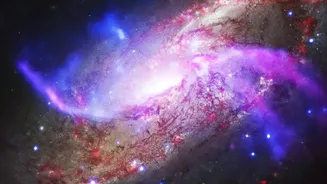
A wandering black hole isn't the only type of off-center discovery raising new questions. Sometimes, the surprise isn't the location within a galaxy, but the type of galaxy itself. Typically, TDEs have been found in large galaxies because that's where we find supermassive black holes. However, scientists are now finding these destructive events in much smaller 'dwarf' galaxies. One such event, designated AT2020neh, provided compelling evidence of a star being torn apart in one of these smaller galaxies. This is exciting because dwarf galaxies aren't expected to host the same supermassive behemoths found in giants like the Milky Way. Instead, they are the perfect hunting ground for a different, much more elusive class of black hole.
The Hunt for the 'Missing Link'
This brings us to the central scientific question: the search for intermediate-mass black holes (IMBHs). Astronomers have solid evidence for two main sizes of black holes: small, stellar-mass ones (a few times the mass of our sun) and the supermassive variety (millions to billions of times our sun's mass). But what about the ones in between? IMBHs, with masses from a hundred to a few hundred thousand suns, are the theoretical 'missing link' in black hole evolution, but they have been incredibly difficult to find. Because dwarf galaxies are smaller, they are thought to host these smaller IMBHs at their centers. Finding a TDE in a dwarf galaxy, therefore, is not just about witnessing a star's demise; it's one of the best methods we have to confirm the existence and measure the mass of these long-sought-after objects, helping us piece together how black holes grow.