





An 'Eye in the Sky' Like No Other
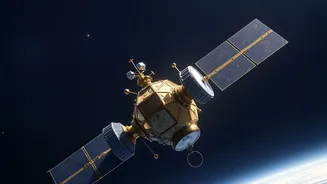
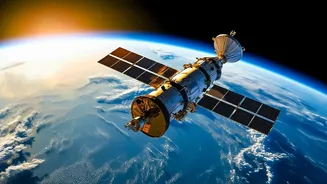
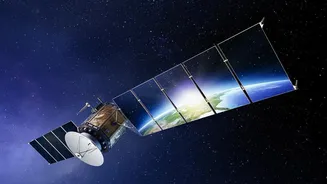
At its core, an Earth-observation (EO) satellite is ISRO's tool for monitoring our planet. But EOS-05 is no ordinary satellite. It is India's first imaging satellite placed in a high-altitude Geosynchronous Orbit (GEO), roughly 36,000 kilometres above
the Earth. Unlike satellites in Low Earth Orbit (LEO) that pass over a location only at certain times, a satellite in GEO matches the Earth's rotation. This allows it to 'hover' over the Indian subcontinent, providing continuous, real-time imagery. Dubbed a state-of-the-art spacecraft, EOS-05 is designed for persistent monitoring of the Indian landmass and its surrounding oceans, a capability that has immense strategic value. This constant watch is crucial for tracking rapidly developing weather events, managing natural disasters, and enhancing security.
Why Weight Matters in Space
The satellite's designation as the heaviest EO satellite launched by a GSLV, weighing in at 2,367 kg, is a crucial detail. In space technology, weight is not just a number; it's a direct indicator of capability. A heavier satellite can carry a more complex and powerful suite of instruments. In the case of EOS-05, this includes advanced imaging tools that can see in multiple spectral bands, from visible light to infrared, allowing it to gather detailed information about everything from crop health to atmospheric aerosols. More weight also means more fuel. This extra fuel allows the satellite to perform more manoeuvres to adjust its orbit and extends its operational lifespan, ensuring it can serve the nation for many years. Launching such a heavy satellite into a precise orbit is a testament to the growing power of India's launch vehicles.
The GSLV: India’s Powerful Lift
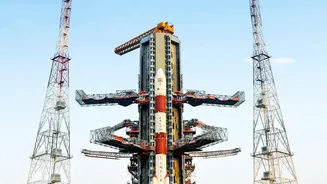
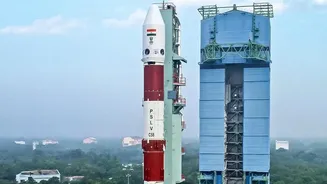
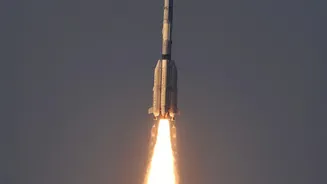
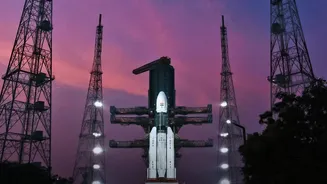
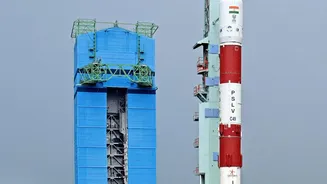
Lifting a heavy satellite like EOS-05 to a high orbit requires a powerful and reliable rocket. The mission was accomplished by India's Geosynchronous Satellite Launch Vehicle (GSLV), specifically the GSLV-F17. The GSLV family of rockets are ISRO's workhorses for placing heavy payloads into high-energy orbits. The rocket's most critical component is its cryogenic upper stage, which uses super-cooled liquid hydrogen and liquid oxygen as propellants. This technology is more efficient and provides greater thrust than solid or conventional liquid fuels, making it essential for such demanding missions. The successful launch of EOS-05 aboard the GSLV demonstrates ISRO's mastery over this complex technology, a journey that has seen both challenges and triumphs, including the successful improvement of the GSLV's performance over time.
Real-World Benefits for India
The advanced capabilities of EOS-05 translate directly into tangible benefits for the country. Its ability to provide near real-time imagery will revolutionize disaster management, allowing authorities to track the development of cyclones, monitor widespread floods, and detect forest fires with unprecedented speed. For agriculture, the satellite's multispectral sensors can provide vital data on soil health, crop stress, and water availability, helping to improve yields and ensure food security. Furthermore, EOS-05 serves a critical strategic purpose. By maintaining an uninterrupted watch over India's land and sea borders, it significantly boosts the nation's surveillance and security capabilities, providing crucial intelligence and situational awareness.
A Resounding Success and a Look Ahead
The successful launch of EOS-05 is particularly significant as it follows the unsuccessful GSLV-F10 mission in 2021, which failed to place the similar EOS-03 satellite into orbit due to a technical anomaly in the cryogenic stage. The triumphant launch of EOS-05, also known as GISAT-1A, serves as a replacement and an operational success, marking ISRO's first major launch of 2026. It underscores ISRO’s resilience and ability to learn from setbacks. This mission is not just a single victory but a stepping stone, paving the way for even more advanced and heavier satellites in the future. As India continues to expand its space infrastructure, satellites like EOS-05 will form the backbone of a system that drives economic development, ensures citizen safety, and secures national interests.