




What Does 'Less Productive' Mean?
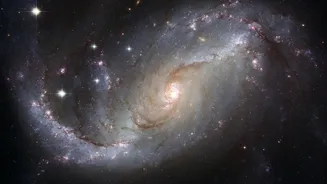
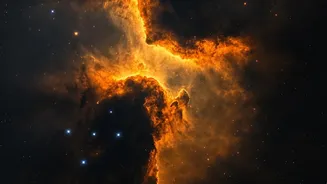
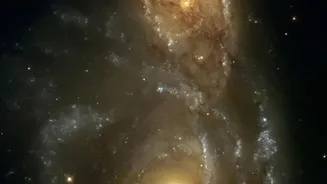
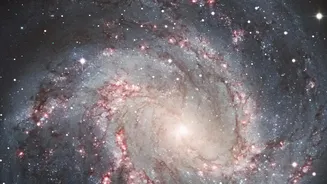
In the context of a galaxy, 'productivity' refers to its rate of star formation. Galaxies are immense cosmic factories, turning vast clouds of gas and dust into brilliant new stars. The Triangulum galaxy, also known as Messier 33 (M33), is the third-largest
member of our local cluster of galaxies, after Andromeda and our own Milky Way. For a long time, it has been a lively stellar nursery. In fact, its rate of star formation per unit area has been observed to be higher than that of the much larger Andromeda galaxy. However, recent studies suggest this period of high activity may be drawing to a close. The galaxy's 'productivity' is measured by how much solar mass—the mass of our Sun—is converted into new stars each year. A decline means the galaxy is building fewer new stars than it used to, a sign that it is beginning to age.
Gathering Clues from 3 Million Light-Years Away
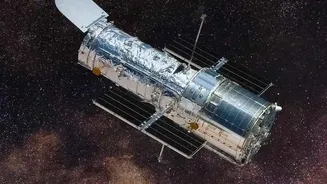
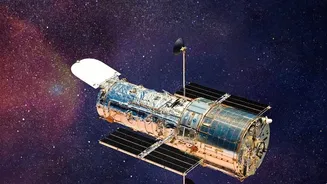
Observing these changes required the advanced capabilities of telescopes like the Hubble Space Telescope and, more recently, the James Webb Space Telescope (JWST). These powerful observatories can peer through the cosmic dust that often obscures stellar nurseries. By capturing images in infrared light, astronomers can get a clearer picture of what's happening deep inside. These telescopes allow scientists to create detailed maps of the galaxy, resolving millions of individual stars. By studying the types and ages of these stars—hot, blue, young stars versus cooler, red, older stars—astronomers can build a 'fossil record' of the galaxy's star-forming history over hundreds of millions of years. It’s like being a cosmic archaeologist, digging through layers of starlight to understand the past.
Running Low on Fuel
The primary reason for this slowdown is likely a depletion of the raw materials needed for star birth. Stars form from dense clouds of cold molecular gas. While the Triangulum galaxy is still rich in gas, the most active star-forming regions may be using up their fuel faster than it can be replenished. This is a natural part of a galaxy's evolution. Some studies suggest a stream of hydrogen gas connects Triangulum with the larger Andromeda galaxy, indicating a past interaction that might have stirred up gas and triggered a burst of star formation. A galaxy can experience periods of intense activity followed by a natural winding-down phase as the easily accessible fuel is consumed. The current decline in productivity suggests Triangulum may be entering such a quieter period after a more energetic youth.
A Glimpse into Our Cosmic Future
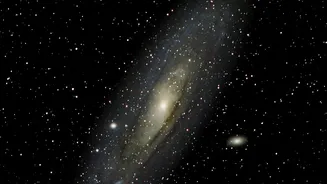
The story of Triangulum is not just about a distant galaxy; it offers a preview of what might be in store for our own cosmic neighbourhood. Our nearest large neighbour, the Andromeda galaxy, is also showing signs of a steady decline in star formation over the last 500 million years. The Milky Way itself will one day exhaust its primary reservoirs of star-forming gas and slowly fade. Furthermore, Triangulum is caught in a gravitational dance with the much larger Andromeda galaxy. In billions of years, Andromeda is set to collide with our own Milky Way, and Triangulum could be pulled into the fray, either merging with Andromeda or being thrown into the massive collision. Observing its current state helps astronomers model these future events and understand the life cycles of spiral galaxies across the universe. It’s a reminder that the night sky, while seemingly permanent, is a place of constant and dramatic change.