
The Science of the Unseen Wobble
The traditional way to find an exoplanet, a planet outside our solar system, is to watch for the dip in a star's light as the planet passes in front of it—an event called a transit. But what about planets whose orbits don't align perfectly for this to happen?
Astronomers have a clever, albeit incredibly difficult, method called astrometry. This technique doesn't look for the planet's light at all. Instead, it measures the precise position of the host star in the sky. When a massive planet orbits a star, its gravitational pull causes the star to wobble around their common center of mass. Think of a large person walking a very small, energetic dog; the person gets pulled around slightly by the dog's movements. From light-years away, Webb's sensitive instruments can detect this minuscule stellar wobble, revealing the presence and mass of an unseen planetary companion.
A Landmark Achievement for Webb
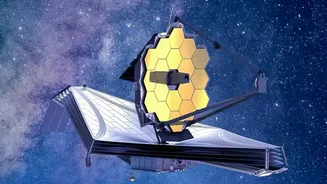
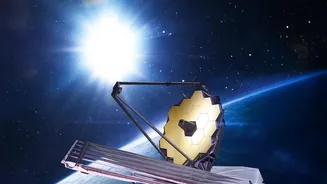
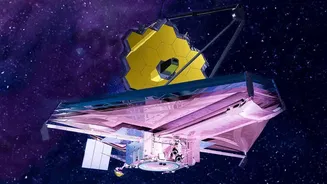
While the concept of astrometry isn't new, using it successfully requires almost unimaginable precision. The wobble of a star caused by an orbiting planet can be infinitesimally small when viewed from Earth. For years, this method has been notoriously challenging, leading to very few confirmed planet discoveries. This is where the James Webb Space Telescope changes the game. Webb is an engineering marvel of stability. Floating in a gravitationally stable point in space far from Earth, it can hold its gaze on a target with incredible steadiness, free from the atmospheric distortions that plague ground-based telescopes. This stability allows it to measure the positions of stars with the high precision needed for astrometry, a feat that was previously at the edge of our technological capabilities. This recent discovery marks the first time Webb has successfully used astrometry to find a new exoplanet, adding a powerful new tool to its planet-hunting arsenal.
Why This Method Matters
The astrometry method is more than just a party trick; it's a vital complement to other detection techniques like the transit method. The transit method is biased towards finding large planets that orbit very close to their stars, as these produce the most noticeable and frequent dips in light. Astrometry, however, excels at finding planets in different situations. It is particularly effective for detecting planets with long orbital periods that are far from their star. It can also work for systems where the planet's orbit is viewed face-on from our perspective, a scenario where a transit would never occur. Furthermore, astrometry allows astronomers to calculate a planet's true mass, whereas other indirect methods often only provide a minimum estimate. This provides a much more complete picture of the planet and its system.
Opening a New Frontier in Planet Hunting
By successfully demonstrating this capability, the Webb telescope is now poised to uncover a different class of exoplanets that have remained hidden from other search methods. Scientists are hopeful that this will lead to the discovery of worlds in configurations more like our own solar system, with giant planets orbiting much farther out. Each new detection method gives us a more complete census of the planets in our galaxy, revealing the sheer diversity of worlds that exist. From scorching hot Jupiters to icy giants, every discovery helps scientists piece together the grand story of how planetary systems form and evolve. With its unparalleled precision and now-proven astrometric skills, the James Webb Space Telescope is writing an exciting new chapter in that story, showing us that sometimes, the most profound discoveries are made by observing what we can't directly see.