





A Protective Bubble in Space
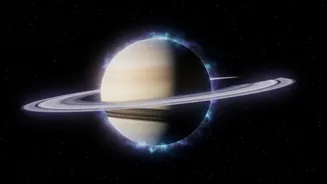
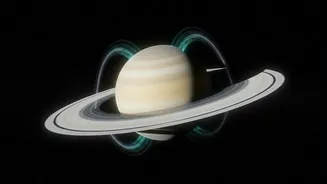
First, let’s get our bearings. Many planets, including Earth and Saturn, have a magnetic field. This field creates a massive, invisible bubble around the planet called a magnetosphere. Think of it as a planetary force field. It deflects most of the harmful,
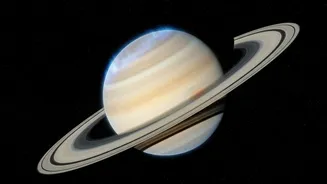
high-energy particles streaming from the sun, known as the solar wind. Without our magnetosphere, Earth’s atmosphere would be stripped away, and life would be impossible. For decades, scientists used Earth’s magnetosphere as the primary model. But Saturn, as it so often does, has proven to be far stranger. While its magnetosphere is the second largest in the solar system, after Jupiter's, recent findings show it operates by a different set of rules.
Saturn’s Long-Standing Puzzles
Scientists have long been intrigued by two major oddities concerning Saturn. The first is its magnetic field, which is almost perfectly aligned with the planet's rotational axis. On Earth and Jupiter, the magnetic axis is noticeably tilted. This tilt is believed to be essential for generating and sustaining the magnetic field through a process called a dynamo. Saturn’s lack of tilt has long challenged scientific models. The second puzzle is the source of the plasma—a sea of charged particles—that fills its magnetosphere. We now know that a huge amount of this material is supplied by the icy moon Enceladus, which spews water vapour from geysers at its south pole. This material gets ionized and becomes a major player in Saturn's magnetic environment.
The New Discovery: A Lopsided Shield
A new study based on years of Cassini data has revealed a fundamental difference in how Saturn’s shield works. On Earth, the solar wind creates openings in our magnetosphere near the poles, called cusps, which are typically located on the side of the planet facing the sun, around local noon. Scientists have just discovered this is not the case for Saturn. Researchers found that Saturn's cusps are pushed far to the side, into the planet's afternoon and evening sectors. Instead of being at noon, the opening is often found between 1 p.m. and 3 p.m. local Saturn time, and sometimes even later. This discovery confirms that Saturn’s magnetosphere is not just a bigger version of Earth’s; it is fundamentally different.
Why Rotation is King at Saturn
So what causes this dramatic shift? The answer lies in Saturn’s immense rotational speed and the sheer amount of material from its moons. Saturn completes a day in just over 10.5 hours. This rapid spin, combined with the heavy load of plasma from Enceladus, creates powerful forces within the magnetosphere. These internal forces are so strong that they overpower the influence of the solar wind. Essentially, Saturn's own spin is dragging its magnetic field and the cusps along with it. On Earth, the solar wind is the primary force shaping our magnetosphere. At Saturn, the planet itself is in charge. This confirms a long-held theory that for giant, fast-spinning planets, internal dynamics can become the dominant factor.
What This Means for Science
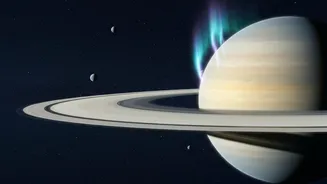
This finding has significant implications. It forces scientists to rethink models of how magnetospheres work, not just at Saturn, but across the galaxy. Understanding how Saturn's lopsided shield funnels particles into its atmosphere provides new insights into the planet’s powerful auroras. More importantly, as we discover more exoplanets—planets orbiting other stars—many of them will likely be gas giants similar to Saturn. This new understanding of how a fast-rotating planet's magnetosphere behaves provides a crucial new framework for studying these distant worlds and assessing their environments. It’s a powerful reminder that our own planet is not always the standard for how the universe works.