

A Tale of Three Encounters
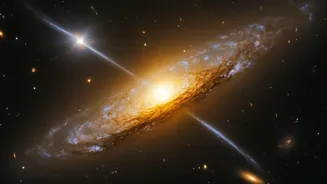
The image, captured by Rafael Sampaio, showcases three duos from the Centaurus Galaxy Cluster, each telling a different story of gravitational interaction. At the top, a polar ring galaxy, NGC 4650A, hints at a violent collision in its past, though it isn't
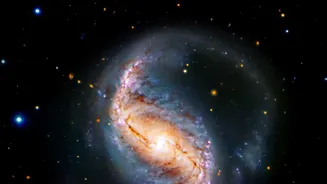
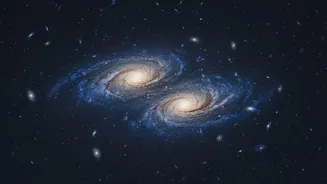
currently interacting with its neighbour. The middle pair seems close, but their relative speeds make a current interaction unlikely. It’s the bottom pair, NGC 4622A and NGC 4622B, that steals the show. They are actively engaged in a gravitational dance, a slow-motion collision that will see them merge into a single, larger galaxy over the next billion years or so. This isn't a single event, but a cross-section of galactic life, showing past, potential, and present interactions all at once.
The Science of Cosmic Collisions
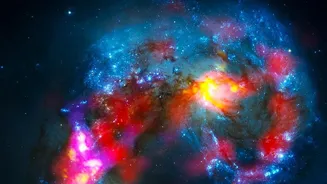
When galaxies collide, it’s not the explosive crash one might imagine. Since galaxies are mostly empty space, individual stars rarely, if ever, hit each other. Instead, the dominant force is gravity. As two galaxies draw near, immense gravitational forces, known as tidal forces, begin to stretch and distort their shapes, pulling out long streams of stars and gas called tidal tails. These interactions are messy and chaotic, scrambling the once-orderly orbits of billions of stars in a process called “violent relaxation.” The gas and dust clouds within the galaxies, however, do collide, compressing the material and triggering furious bursts of star formation, creating what astronomers call a “starburst” galaxy. These events are fundamental to how galaxies grow and evolve over cosmic time.
A Preview of Our Own Future
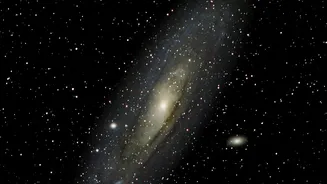
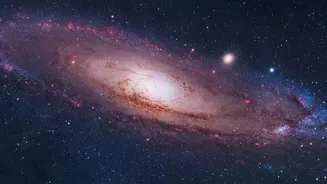
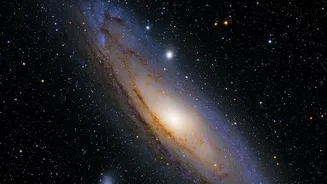
These snapshots of distant mergers provide a glimpse into the eventual fate of our own home galaxy, the Milky Way. Astronomers predict that in about 4.5 billion years, our galaxy will collide with its nearest large neighbour, the Andromeda galaxy. Just like the galaxies in NASA's new image, the two will dance around each other for hundreds of millions of years, their spiral arms distorting and merging. The collision will ignite a spectacular burst of star formation, and eventually, the two will coalesce into a new, larger, and likely elliptical-shaped galaxy. Studying mergers like Arp 142 or NGC 7764A allows scientists to refine their computer simulations and better understand the epic event awaiting our distant descendants.
The Cosmic Perspective
Observing these galactic pairs does more than just inform astronomical models; it shifts our perspective. These processes, which unfold over hundreds of millions of years, remind us of the immense timescales on which the universe operates. What appears to us as a static image is a snapshot of one of the most powerful and creative events in the cosmos, second only to the Big Bang in terms of energy output. It highlights a universe that is not static or serene but dynamic, constantly changing, and built upon cycles of collision and creation. These encounters were even more common in the early universe when galaxies were packed more closely together, playing a crucial role in shaping the cosmos we see today.