



A More Complex Martian Past
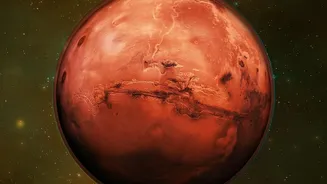
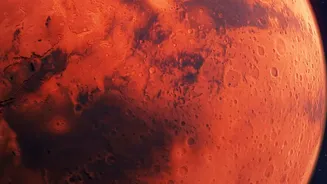
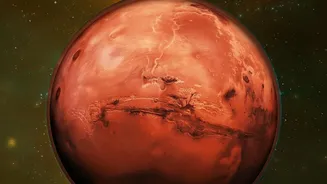
Mars has long been considered a 'stagnant lid' planet, meaning its surface is a single, solid plate, unlike Earth's which is broken into shifting tectonic plates. This lack of plate tectonics, which drives volcanism and continent-building on our home
world, led scientists to assume Martian geology was relatively simple. However, a new study published in Nature Astronomy challenges this long-held belief. Researchers have found compelling evidence that Mars once possessed enormous, complex magmatic systems similar to those on Earth, suggesting a far more dynamic interior than previously imagined.
Listening to the Heartbeat of Mars
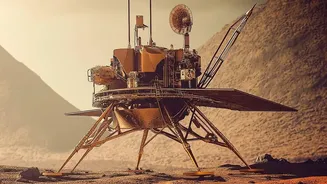
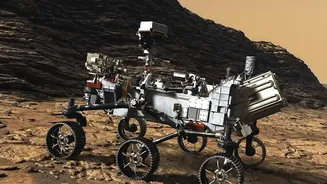
The breakthrough comes from analysing data meticulously collected by NASA's InSight lander. From 2018 to 2022, InSight's sensitive seismometer recorded the faint vibrations from 'marsquakes' and meteoroid impacts. These seismic waves, travelling through the planet's interior, act like a planetary-scale ultrasound. A team from Oxford's Departments of Earth Sciences and Statistics used these recordings to investigate a mysterious boundary located about 24 kilometres beneath the Martian surface. By comparing the seismic data with hundreds of possible rock compositions, they determined what this layer was likely made of.
An Underground Magma Network
The analysis revealed that the boundary likely marks where molten rock once pooled deep underground. The models showed that below this 24km line, the rock is rich in iron and magnesium, while the rock above contains more silica. This suggests a process where magma gradually separated into different materials; dense crystals sank to form a thick residue at the base of the crust, while lighter, more evolved melts rose upwards. Crucially, the study suggests this layer isn't isolated but may extend for hundreds or even thousands of kilometres across Mars's northern hemisphere. This points not to simple, individual volcanoes, but to a vast, interconnected plumbing system—a phenomenon known as 'transcrustal magmatism' that, until now, was thought to be unique to Earth.
Rethinking a 'Dead' Planet
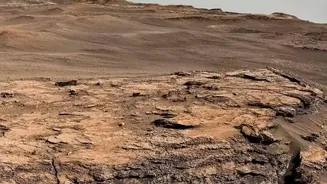
This discovery forces a major rethink of Mars's geological history. It indicates the planet was capable of producing a highly evolved and complex crust through intense internal recycling, even without the engine of plate tectonics. While the volcanoes on Mars are now considered dormant or extinct, this finding shows their underlying systems were long-lived and intricate. It suggests a world that was, at one point, far more geologically vibrant than its current cold, dusty surface lets on. This sustained internal activity is closely linked to the processes that help planets develop atmospheres and oceans, potentially regulating climate over long timescales.
Implications for Life and Future Exploration
The presence of such complex geological systems has profound implications. These processes are fundamental to how rocky planets can become habitable. On Earth, similar systems help regulate the climate and cycle elements like water. The discovery could also have a more practical benefit for future explorers. The same geological processes that create these evolved magma systems are known to generate large metal deposits. This raises the possibility that Mars may hold significant near-surface mineral wealth, a factor that could be crucial for future crewed missions and potential settlements.