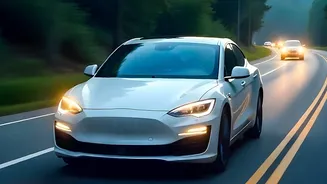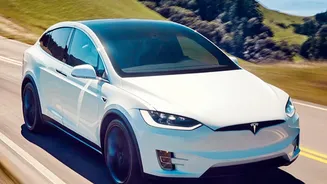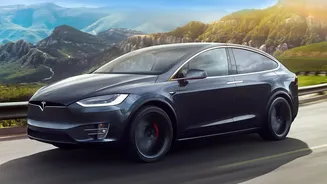

Tesla’s All-Seeing Eyes
At the heart of Tesla's self-driving ambition is a system called Tesla Vision. Unlike many competitors that use a combination of cameras, radar, and LiDAR (a system that uses lasers to create a 3D map of the world), Tesla has committed to a vision-only
approach. It relies on a suite of eight cameras that provide a 360-degree view around the car. This visual data is fed into a powerful neural network, which acts as the car's brain, interpreting the world and predicting the actions of other road users. The philosophy is that if humans can drive with two eyes, a car with eight cameras and a supercomputer should be able to do it better. This system is trained on billions of miles of real-world driving data, allowing it to learn from countless scenarios. However, most of this training data comes from more structured Western traffic environments, a critical factor when considering the Indian context.
The Unpredictable Dance of Indian Streets
Indian roads operate on a different wavelength. The flow is less about rigid lanes and more about fluid movement. This is especially true for pedestrians and two-wheelers, which constitute a significant portion of traffic and fatalities. Motorcyclists weave between cars, auto-rickshaws make sudden stops, and pedestrians cross streets wherever they see a gap, often at uncontrolled junctions without signals or police. This behaviour is not just random; it's a complex, shared understanding of negotiation and adjustment that human drivers learn through experience. For an AI trained on rule-based driving, this environment is a cascade of constant surprises. The system struggles when traffic doesn't follow textbook patterns, and in India, the textbook is often irrelevant. The sheer density and heterogeneity of traffic, from cyclists and animal carts to buses and trucks, create a level of complexity far beyond that of a typical highway or suburban street in the US.
Data Overload and Prediction Failure
Tesla's AI must not only see an object but also predict its intent. Is that pedestrian waiting to cross, or just standing by the road? Will that scooter swerve left or right? In orderly traffic, these predictions are easier. On an Indian street, a single frame of video can contain dozens of moving agents, each with its own unpredictable trajectory. This creates a massive computational challenge. Furthermore, the system can get confused by scenarios it hasn't been extensively trained on. A rider on a motorcycle carrying bulky luggage, a family of four on a single scooter, or a street vendor pushing a cart are common sights in India but are considered "edge cases"—rare and unusual events—for a typical autonomous driving algorithm. When the exception becomes the rule, the system can be overwhelmed. This can lead to hesitation, overly cautious braking, or, in the worst-case scenario, a failure to react in time because it cannot confidently classify and predict the movement of an unfamiliar object.
The Challenge for All Autonomous Tech
These complications aren't exclusive to Tesla. Any company aiming to deploy autonomous vehicles in India will face the same fundamental hurdles. Poor road infrastructure, including faded lane markings and potholes, further complicates navigation for any vision-based system. However, Tesla's reliance on cameras alone makes it particularly sensitive to visual 'noise' and unpredictable movements. While the system has shown remarkable ability to react quickly in some scenarios, its reliability in consistently chaotic environments remains a subject of debate. Before full self-driving can become a reality in India, the AI will need to be extensively trained on local data to understand the unique language of Indian roads. It must learn to anticipate the seemingly erratic but internally consistent logic of how pedestrians and two-wheelers navigate their shared spaces.