



A Cosmic Detective Agency
The initiative, aptly named 'Black Hole Hunters', is a citizen science project that invites anyone with an internet connection to become a cosmic detective. Hosted on the Zooniverse platform, the project is a collaboration led by researchers from institutions
like the University of Southampton and the Open University. Their goal is ambitious: to close the massive gap between the estimated 10 million black holes in the Milky Way and the mere handful—around 70—that have been confirmed so far. By turning astronomical data into a pattern-recognition task, they've empowered a global team of volunteers to search for these elusive objects from their own homes.
Why Human Eyes Are Better Than AI
In an age of advanced artificial intelligence, it may seem counterintuitive to rely on human volunteers. While AI is used to perform a preliminary sweep of the vast amounts of data from NASA's Transiting Exoplanet Survey Satellite (TESS), it struggles with the messy reality of the cosmos. Algorithms can be fooled by other celestial events, like stellar flares or the natural pulsations of stars, which can mimic the signs of a black hole. The human brain, however, is exceptionally good at recognizing subtle patterns and filtering out this noise. Volunteers are shown simple graphs representing a star's brightness over time and are asked to identify a specific, tell-tale pattern. This human touch is crucial for narrowing down the list of candidates, allowing professional astronomers to focus their powerful telescopes on the most promising targets.
Hunting for Cosmic Magnifying Glasses
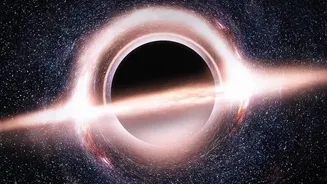
So, what are these volunteers actually looking for? They are searching for a phenomenon known as gravitational microlensing. Many massive stars exist in pairs, known as binary systems. When one star collapses into a black hole, its companion can remain in orbit. If this pair aligns perfectly with Earth, the black hole will periodically pass in front of its companion star. Since black holes themselves are invisible, you can't see them block the light. Instead, their immense gravity bends and magnifies the light from the star behind them, causing it to appear briefly and characteristically brighter. This temporary brightening is the 'smoking gun' that volunteers are trained to spot—a flicker in the data that could signify an invisible giant.
More Than Just a Hobby
The response to the project has been overwhelming. Since its launch, nearly 23,000 volunteers have joined the hunt, collectively making over 12 million classifications. This isn't just busywork; it's a vital contribution to modern astrophysics. Each classification helps refine the search and brings scientists one step closer to confirming a new black hole. The initial volunteer work is also being used to train the next generation of machine learning models, creating a powerful synergy between human intuition and artificial intelligence. Finding these 'quiet' black holes—those not actively feeding on surrounding material—is crucial for understanding how massive stars live and die, how binary systems evolve, and the overall structure of our galaxy. As one project leader noted, any volunteer could be the first to discover a member of this entirely new population of black holes.