



The Most Ambitious Goal in Rocketry
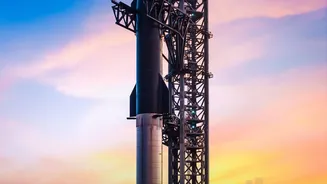
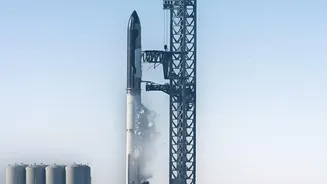
SpaceX’s vision for Starship hinges on full and rapid reusability, which would dramatically lower the cost of spaceflight. The cornerstone of this strategy is catching both the Super Heavy booster and the Starship upper stage directly on the launch tower.
This maneuver, using two giant mechanical arms nicknamed 'chopsticks', eliminates the need for landing legs and gets the rocket ready for its next flight in record time. A successful catch involves the skyscraper-sized booster descending from the sky, performing a precise landing burn to slow to a near-hover, and positioning itself perfectly to be grabbed by the tower arms just feet from the ground. This feat of engineering, first successfully performed by SpaceX in October 2024, is critical to the company's long-term plans for frequent launches to orbit, the Moon, and Mars.
What Happened During Flight 15?
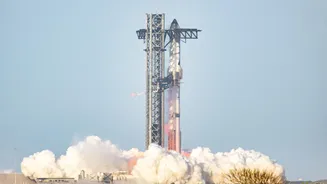
On November 13, 2026, Starship Flight 15 lifted off from Starbase, Texas, on what was planned to be the first mission to recover both the booster and the ship. The initial ascent and the 'hot-staging' separation, where the upper stage ignites its engines before fully separating, went according to plan. The Super Heavy booster, designated Booster 22, then began its boostback burn to return to the launch site. However, instead of lining up for the tower catch, the booster's automated systems called off the attempt. The rocket diverted its trajectory to a designated contingency zone offshore and performed a soft splashdown in the Gulf of Mexico. Shortly after hitting the water, the booster's flight termination system was activated, resulting in a large fireball to safely dispose of remaining propellant.
Why Was the Catch Aborted?
The decision to abort the catch was not a human one, but an automated safety measure. SpaceX commentators later clarified that the booster’s own Guidance, Navigation, and Control (GNC) system triggered the abort. The system detected that the booster was not in the correct position or on the right trajectory to ensure a safe catch. Early indications suggested the issue stemmed from the boostback burn ending early due to a 'low fuel mass alarm'. This could have been caused by a number of factors, including a reported engine failing to light during the burn, leaving the booster without the required performance margins to guarantee it could safely reach the tower. In essence, the onboard computers determined the risk to the launch tower and ground infrastructure was too high and correctly defaulted to the safer backup plan: a splashdown at sea.
A Setback or a 'Successful Failure'?
While the dramatic explosion in the Gulf might look like a major failure, within SpaceX's rapid iterative development process, it is more accurately seen as a data-gathering exercise. The mission was still a partial success. The primary goal of safely reaching orbit was achieved, and the Starship upper stage, Ship 42, went on to successfully deploy 26 Starlink satellites. In a historic first, the Ship was later caught by the tower after spending 22 hours in orbit. The aborted booster catch, while a setback, demonstrated that the safety systems work exactly as designed. Protecting the invaluable launch tower—the 'Mechazilla' structure—is prioritized over recovering a single booster. The data collected from the flight and the abort sequence will be crucial for refining the process for future attempts.
What This Means for SpaceX's Timeline
The aborted catch marks the fourth consecutive loss of an upgraded 'V3' Super Heavy booster, each carrying 33 advanced Raptor engines. While SpaceX has successfully caught earlier booster versions three times, it has yet to recover this newer model. The loss of the booster and its engines is a cost, but one factored into the company's test-driven approach. Engineers will now pour over the flight data to understand the root cause of the low fuel alarm and the boostback burn anomaly. This investigation will likely push back the next attempt at a full 'double catch' of both stages on a single flight. However, given the company's track record, the lessons learned from Flight 15 will be applied quickly, paving the way for another attempt in the near future as SpaceX continues its relentless push toward a fully reusable space transportation system.