





A Heart of Ice
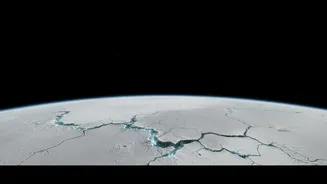
The focus of this surprising discovery is Sputnik Planitia, the western lobe of Pluto's famous heart-shaped feature, Tombaugh Regio. This enormous basin, larger than Texas and Oklahoma combined, is not made of water ice but is filled with frozen nitrogen,
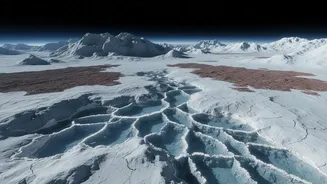
which behaves like a glacier. Data from NASA's New Horizons spacecraft, which flew past Pluto in 2015, revealed that the surface of this plain is remarkably young and crater-free, indicating it is constantly being renewed. The surface is broken into city-sized polygonal cells that are slowly churning in a process of solid-state convection.
A Startling New Theory
For years, scientists have analysed the strange dark streaks and diffuse patches that mark the boundaries of these nitrogen ice cells. A recent study, published in the Planetary Science Journal, proposes a radical new explanation for them. According to a research team led by Alan Stern of the Southwest Research Institute, these features are evidence of liquid nitrogen occasionally welling up from beneath the glacier and wetting the surface before freezing again. This is the first strong evidence for recently flowing liquid on Pluto's frigid surface.
How is Liquid Nitrogen Possible?
The idea of liquid on Pluto, where surface temperatures hover around minus 230 degrees Celsius, seems impossible. The thin atmosphere makes liquid nitrogen rain physically impossible. Instead, scientists propose a process called basal melting. Computer models suggest that, several kilometres beneath the surface, the immense pressure of the overlying nitrogen ice, combined with modest heat from Pluto’s rocky core, could be sufficient to melt the nitrogen at the glacier's base. This liquid nitrogen, being more buoyant than the solid ice above it, could then be forced upward through cracks and fissures, much like magma on Earth.
Clues on the Surface
The evidence for this subsurface liquid comes from comparing the New Horizons images to features here on Earth. Researchers looked at images from the Greenland ice sheet, where meltwater flowing on the surface or emerging from below creates similar dark, wetted patterns on the snow and ice. The resemblance is striking. The dark streaks on Sputnik Planitia look just like these wetted zones, strengthening the case that liquid is the cause. Since the surface is thought to be less than a million years old, these features must have formed very recently in geological terms.
A Dynamic Dwarf Planet
This finding completely overhauls our understanding of Pluto. Far from being a geologically dead snowball, it appears to be an active world with ongoing processes that reshape its surface. It joins a growing list of icy bodies in the outer solar system that show surprising signs of activity. The mechanism proposed for Pluto could even help explain other cosmic mysteries, such as the geysers of nitrogen gas observed on Neptune's moon Triton by the Voyager 2 spacecraft in 1989. It suggests that even in the coldest, darkest corners of our solar system, complex geological processes can still occur, driven by forces we are only just beginning to understand.