





Our galaxy is brimming with powerful and mysterious objects, many of which we are only just beginning to detect. Recently, astronomers pinpointed a source of extremely high-energy gamma rays and, in a new preliminary study, are offering a cautious but
compelling explanation for what it might be.
A New Cosmic Powerhouse
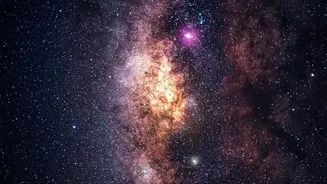
Deep within the Milky Way, something is blasting out particles with incredible force. Observatories have detected a source emitting extremely energetic gamma rays, the most powerful form of light in the universe. These are not the kinds of emissions that come from ordinary stars; they are the signature of violent cosmic events or fantastically powerful celestial engines. The source, identified by instruments like the Large High Altitude Air Shower Observatory (LHAASO), has puzzled scientists. Its discovery adds to a growing list of 'Pevatrons'—cosmic accelerators that can boost particles to peta-electron-volt (PeV) energies, a quadrillion times more energetic than visible light and far beyond what our most advanced particle colliders on Earth, like the Large Hadron Collider, can achieve. The question for researchers is not just that this object exists, but what exactly it is.
The Prime Suspect: A Pulsar Wind Nebula
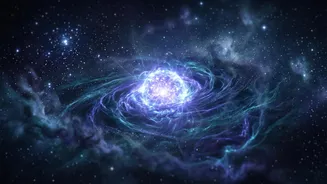
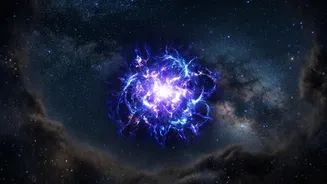
The leading, though tentative, explanation is that the source is a 'pulsar wind nebula'. This sounds complex, but the concept is fascinating. A pulsar is the tiny, super-dense, rapidly spinning core left behind after a massive star explodes in a supernova. Imagine a collapsed star, sometimes only the size of a city, spinning hundreds of times per second. This rapid rotation generates intense magnetic fields and slingshots a powerful 'wind' of particles out into space. This wind slams into the surrounding gas and dust from the original supernova, creating a vast, glowing cloud that shines brightly in high-energy rays—a pulsar wind nebula. The data from the new source, including a specific object named LHAASO J0621+3755, appears to be positionally coincident with a known pulsar, PSR J0622+3749, making this a strong possibility.
Why This Theory Fits (For Now)
The pulsar wind nebula theory is attractive because the energetic 'fingerprint' of the mysterious source matches what models predict such an object would produce. The spectrum of gamma rays observed across a wide range of energies aligns well with theories of electrons being accelerated within these nebulae. However, the 'tentative' and 'preliminary' nature of the study's conclusion is crucial. The primary reason for this caution is that while the nebula's glow has been detected, the pulsar thought to be powering it has not been directly and definitively observed in certain wavelengths, such as X-rays or pulsed radio signals, which would provide the smoking gun. Science demands a high bar for proof, and without a confirmed engine at the center, the explanation remains a well-supported hypothesis rather than a confirmed fact.
Ruling Out Other Cosmic Culprits
When faced with a cosmic mystery, scientists consider multiple possibilities. Other potential sources for such high-energy emissions include the jets from supermassive black holes, energetic regions in 'starburst' galaxies, or even the annihilation of dark matter particles. For years, a diffuse gamma-ray glow from the galactic center has been a subject of debate, with some attributing it to thousands of unresolved millisecond pulsars and others to dark matter. However, for this specific newly identified source, the spatial distribution of the gamma rays and the lack of strong signals in other wavelengths make the pulsar wind nebula a more fitting explanation than some alternatives. The process is one of elimination as much as it is of confirmation, as researchers meticulously compare the observed data with the predicted signatures of each possible type of cosmic source.
The Next Steps in a Galactic Mystery
Confirming the identity of this high-energy source is the next major goal. Astronomers will now likely use a multi-pronged approach. This involves pointing other types of telescopes—like radio arrays and space-based X-ray observatories such as Chandra—at the source's location to hunt for the elusive pulsar at its heart. If they can detect the characteristic 'pulse' of a spinning neutron star, the case would be significantly strengthened. Gathering more data from LHAASO and other gamma-ray detectors will also help refine the measurements of the nebula's shape and energy spectrum, allowing for more precise comparisons with theoretical models. Each new piece of information helps to either build confidence in the leading theory or, potentially, point researchers in an entirely new and unexpected direction.