
Earth's Ever-Moving Jigsaw Puzzle
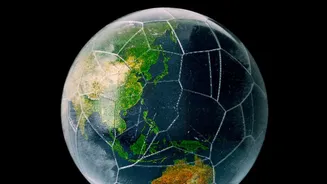
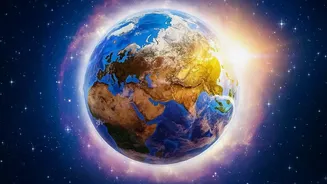
Our planet's surface is not one solid piece. It is broken into massive slabs of rock called tectonic plates, which fit together like a giant jigsaw puzzle. These plates are in constant, slow-motion movement, floating on the semi-fluid mantle beneath them.
This fundamental concept, known as plate tectonics, is the engine driving most of Earth's major geological events, from creating mountains to causing earthquakes. The continents we live on are passengers on these plates, and their positions change over millions of years. This same process is responsible for the changing sizes of our oceans.
The Great Pacific Squeeze
The Pacific Ocean is shrinking because the plates under its floor are being forced underneath the surrounding continental plates in a process called subduction. This happens at what are called convergent boundaries, where two plates collide. Because oceanic crust is generally denser than continental crust, it loses the battle, diving into the Earth's mantle where it melts and is recycled. The Pacific basin is almost entirely surrounded by these subduction zones, which act like a gigantic planetary drain, slowly pulling the edges of the ocean inward.
Welcome to the Ring of Fire
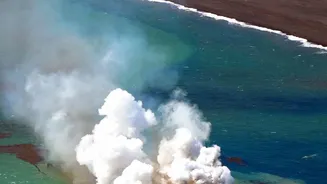
This vast perimeter of subduction zones around the Pacific is famously known as the Ring of Fire. Stretching for about 40,000 kilometres, this horseshoe-shaped belt is home to roughly 75% of the world's volcanoes and is where about 90% of all earthquakes occur. When an oceanic plate sinks, the immense friction and heat cause rock to melt, creating magma. This magma, being less dense than the surrounding rock, rises to the surface, feeding the volcanoes that dot the coastlines of places like Japan, New Zealand, and the Americas. The stress and movement at these boundaries also release massive amounts of energy, triggering frequent earthquakes.
A Tale of Two Oceans
While the Pacific is shrinking, the Atlantic Ocean is doing the opposite—it's getting wider. This is because the Atlantic is dominated by a different kind of plate boundary: a divergent boundary. Running down the centre of the ocean is the Mid-Atlantic Ridge, a massive underwater mountain range where tectonic plates are pulling apart. Molten rock from the mantle rises to fill this gap, creating a new seafloor in a process called seafloor spreading. Since the Atlantic has very few subduction zones to consume its crust, this creation of new crust leads to its net expansion, pushing the Americas further from Europe and Africa by about 4 centimetres each year.
Don't Sell Your Beachfront Property Yet
This geological drama unfolds on a timescale almost too vast for us to comprehend. The Pacific Ocean is shrinking at a rate of just a few centimetres per year. While this may seem insignificant, over millions of years, it adds up to a dramatic planetary rearrangement. This process is part of Earth's supercontinent cycle, where landmasses periodically merge into one giant continent and then break apart again. The last supercontinent, Pangaea, broke apart around 200 million years ago.
A Glimpse into the Far Future
Scientists using supercomputer simulations have forecasted what our world might look like in the distant future. One prominent theory suggests that as the Pacific continues to close, the Americas will eventually collide with Asia. In about 200 to 300 million years, this could lead to the formation of a new supercontinent, which some have named 'Amasia'. This is a natural continuation of a cycle that has shaped our planet for billions of years, driven by the same quiet, relentless forces that are at work deep beneath the ocean floor today.