




The Great Land Squeeze
India's push for solar power is central to its climate commitments and growing energy needs. The country is home to some of the world's largest solar parks, like the massive Bhadla Solar Park in Rajasthan, which blankets vast stretches of arid land. However,
this model faces a significant hurdle: land is a finite and often contentious resource. Utility-scale solar projects require thousands of acres, which can lead to competition with agriculture, spark disputes with local communities, or encroach on ecologically sensitive areas. In a densely populated nation where farmland is vital and development needs are pressing, simply finding enough non-controversial land for the next wave of solar expansion has become a major challenge for policymakers and developers alike.
A Two-Pronged Solution Emerges
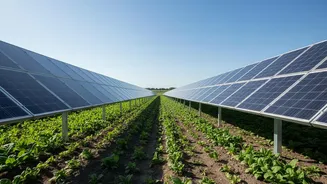
Instead of focusing solely on acquiring large, empty tracts of land, India's new approach is to integrate solar power into existing landscapes. This strategy is unfolding primarily in two innovative ways: floating solar photovoltaics (FSPV) and agrivoltaics. The first involves installing solar panels on buoyant platforms on water bodies like reservoirs and dams. The second, agrivoltaics, combines solar power generation with agriculture, placing elevated panels over fields where crops continue to grow underneath. Both methods aim to generate clean energy while minimising the need for dedicated land acquisition, turning existing resources into dual-purpose assets.
Solar on the Water: Floating Farms
Floating solar is rapidly moving from a niche concept to a key part of India's energy strategy. In July 2026, the Union Cabinet approved the Pradhan Mantri Surya Sarovar Yojana, a major scheme to deploy 5,000 MW of floating solar capacity. Large-scale projects are already operational or under construction, such as the plants at Ramagundam in Telangana and the massive 600 MW project planned for the Omkareshwar dam in Madhya Pradesh. These projects offer multiple benefits. The water has a natural cooling effect on the panels, which can boost their efficiency and energy generation. Additionally, the panels reduce water evaporation from reservoirs—a crucial benefit in water-scarce regions—and can share existing grid infrastructure from nearby hydropower dams, making them more cost-effective to connect.
Farming Under Panels: Agrivoltaics
Agrivoltaics presents a powerful vision for rural India: allowing farmers to harvest both crops and energy from the same piece of land. Initiatives like the Pradhan Mantri Kisan Urja Suraksha evam Utthaan Mahabhiyan (PM-KUSUM) scheme are central to this push. The scheme encourages farmers to install solar power plants on their land, which can be used to power irrigation pumps and sell surplus electricity to the grid, creating an additional income stream. Research and pilot projects across the country are exploring which crops, such as shade-tolerant spices or vegetables, grow best under the panels. For farmers, this model offers a buffer against fluctuating crop prices and climate uncertainty, transforming their fields into hubs of both food and energy production.
Challenges on the Horizon
Despite the immense potential, this new approach is not without its difficulties. Both floating solar and agrivoltaics currently have higher upfront costs compared to conventional ground-mounted systems due to specialized equipment like floating platforms, mooring systems, and elevated structures. For floating solar, there are engineering complexities in designing systems that can withstand waves and changing water levels, as well as unanswered questions about the long-term environmental impact on aquatic ecosystems. Similarly, agrivoltaics requires more research to optimize crop yields and develop scalable business models that are attractive to small farmers. Overcoming these technical and financial hurdles will be crucial for these technologies to be adopted at a national scale.