







Meet the SPHEREx Telescope
Launched in March 2025, NASA's SPHEREx (Spectro-Photometer for the History of the Universe, Epoch of Reionization, and Ices Explorer) is an ambitious mission designed to create a 3D map of the entire sky. Unlike telescopes that focus on one small patch
of the cosmos, SPHEREx surveys everything, completing a full map every six months. It does this by measuring near-infrared light, which is invisible to the human eye but holds the chemical fingerprints of cosmic objects. By capturing the light from hundreds of millions of galaxies and stars in 102 different colour bands, SPHEREx can identify the molecular makeup of distant worlds. While its main goals are to study the origins of the universe and galaxies, this powerful survey capability makes it perfect for investigating other cosmic mysteries as a side project.
What Exactly Are 'Failed Stars'?
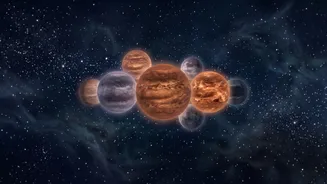
The subjects of this latest discovery are brown dwarfs, often called 'failed stars'. These celestial objects are in a class of their own, more massive than giant planets like Jupiter but not quite massive enough to become stars. They are born the same way stars are: from the collapse of a giant cloud of gas and dust. However, they never accumulate enough mass—falling short of the roughly 80-Jupiter-mass threshold—for their cores to get hot and dense enough to ignite the sustained hydrogen fusion that powers stars like our Sun. Instead, after a brief period of fusing a heavier hydrogen isotope called deuterium, they spend the rest of their existence slowly cooling and fading, glowing faintly from their internal heat. This makes them incredibly dim and difficult to spot, drifting through space as lonely, independent worlds.
A Surprising Chemical Cocktail
Using SPHEREx, astronomers analyzed the atmospheres of 37 nearby brown dwarfs across a wide range of temperatures. The telescope's spectra revealed that these dim worlds have chemically complex atmospheres, containing water, methane, carbon monoxide, and carbon dioxide. While molecules like water and methane have been detected in brown dwarf atmospheres before, SPHEREx's all-sky survey is observing thousands of them, providing an unprecedented look at their diversity. Researchers found that no two brown dwarfs are exactly alike; even at the same temperature, their chemical signatures can be quite distinct. As these objects cool over their lifetimes, their atmospheric chemistry changes, with some showing a transition where clouds of mineral grains thin out and methane becomes a dominant feature.
Why This Discovery Is a Big Deal
Finding these molecules isn't about discovering life on brown dwarfs themselves, but about understanding the ingredients of the universe. Brown dwarfs are natural laboratories for studying atmospheres that are similar to those of giant gas planets, but without the blinding glare of a host star. This allows scientists to get a much clearer view of the chemistry at play. The data from SPHEREx shows that current atmospheric models are good at predicting the general chemical trends but struggle to explain the complex details, especially during the cloudy transition phase. This discovery challenges scientists to refine their models of how atmospheres on cool objects behave, which has implications for understanding exoplanets as well. It reveals just how diverse and complex these 'in-between' objects are, turning astronomers into 'accidental meteorologists' as they try to understand the weather on these strange worlds.
The Next Chapter in Cosmic Exploration
The SPHEREx mission is just getting started, and these 37 brown dwarfs are only the first batch from a catalog that will eventually include thousands. This wealth of data will help scientists create a more complete picture of how objects from the smallest stars to the largest planets form and evolve. It also complements the work of other powerful observatories like the James Webb Space Telescope (JWST), which can perform deep-dive studies on individual brown dwarfs identified by SPHEREx. For instance, recent JWST findings suggest some cold brown dwarfs may even have aurorae, hinting at energetic processes in their upper atmospheres. By mapping the prevalence of water and other key molecules across the galaxy, SPHEREx is helping to trace the cosmic origins of the building blocks necessary for life as we know it.