




Looking at the Sun’s Siblings
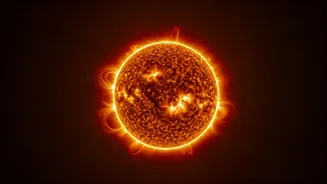
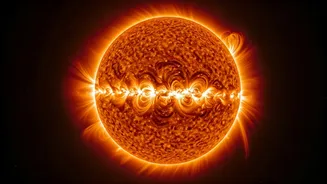
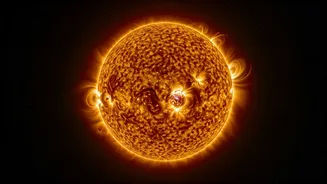
To understand the long-term behaviour of any one person, you might look at their family. Astronomers do something similar with stars. Our Sun is a G-type main-sequence star, a celestial classification it shares with billions of other stars in our galaxy.
By studying these 'solar siblings,' we can get a glimpse into our own Sun's potential past and future behaviour over timescales far longer than human history. This is where NASA's Kepler space telescope comes in. Though famous for discovering thousands of exoplanets, its primary mission involved staring intently at a patch of sky, recording the brightness of over 150,000 stars. This massive, uninterrupted dataset is a treasure trove for scientists looking for more than just orbiting planets; it's a record of stellar activity, including dramatic, violent outbursts.
Hunting for Stellar Fireworks
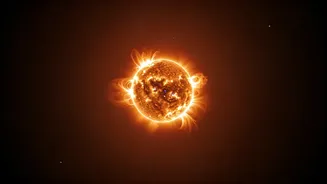
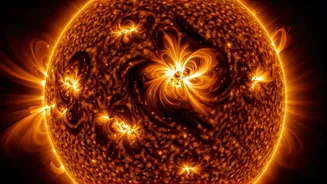
A team of researchers from Nagoya University in Japan decided to comb through this vast archive of Kepler data with a specific target in mind: superflares. A superflare is a colossal explosion on a star's surface, releasing energy that can be hundreds or even thousands of times greater than the most powerful solar flares ever recorded from our own Sun. The most famous solar storm in our history, the 1859 Carrington Event, was powerful enough to set telegraph offices on fire and create auroras visible near the equator. A superflare would make it look like a minor firecracker. The Nagoya team focused their analysis on stars that were remarkably similar to our Sun in size, temperature, and, crucially, rotation speed. It was long thought that only young, rapidly spinning stars were capable of such extreme events. The question was whether slow-rotating, middle-aged stars like our Sun could do the same.
A Startling Statistical Truth
The results of their painstaking analysis provide a crucial piece of context for our place in the cosmos. The researchers found thousands of superflares erupting from sun-like stars, including those that were rotating as slowly as our own Sun. This discovery directly challenged the old assumption that our star was too calm and stable for such fury. By counting the number of superflares on thousands of stars over the years of Kepler's observations, the team was able to calculate the statistical frequency of these events. Their findings suggest that a superflare with energy about 100 times that of the Carrington Event could occur on a star like our Sun approximately once every few thousand years. While this is infrequent on a human timescale, it is a shocking revelation in geological and astronomical terms, transforming a theoretical possibility into a statistically predictable hazard.
From the Cosmos to Our Power Grid
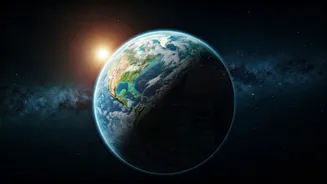
This research is not just an academic curiosity. The implications of a superflare striking Earth are profound. The Carrington Event happened before the world was draped in a sensitive electronic web. A similarly powerful event today would be catastrophic, potentially crippling global satellite networks responsible for communication, navigation, and financial transactions. It could induce powerful currents in national power grids, causing widespread, long-lasting blackouts and damaging critical infrastructure beyond easy repair. The Nagoya research effectively serves as a planetary risk assessment. By understanding that our Sun is capable of producing these events, and how often they might occur, we are better equipped to prepare. It underscores the critical importance of 'space weather' forecasting and developing more resilient infrastructure on Earth and in orbit.