




The Classic Story of a Cosmic Crash
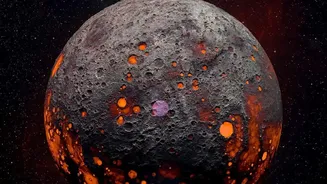
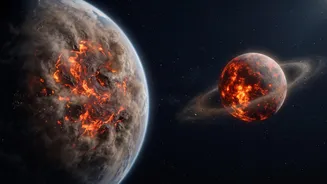
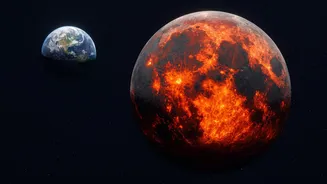
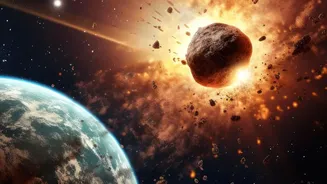
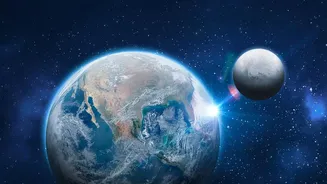
For many years, the leading explanation for the Moon's existence has been the "Giant-Impact Hypothesis." This theory proposes that about 4.5 billion years ago, a young, developing Earth was struck a glancing blow by a Mars-sized protoplanet named Theia.
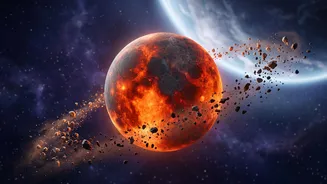
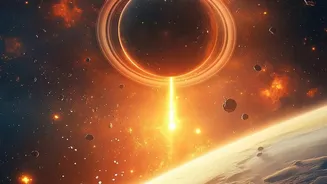
The cataclysmic impact would have vaporized Theia and blasted a massive ring of molten rock, gas, and debris into orbit around Earth. Over thousands or even millions of years, this debris disc would have slowly clumped together due to gravity, eventually coalescing to form the Moon we see today. This story elegantly explained several key features, such as the Moon's smaller iron core and why its orbit is tilted. Analysis of rock samples brought back by Apollo astronauts, which showed remarkable similarities to Earth's mantle, provided strong supporting evidence for a shared origin.
A New, Faster Origin Story
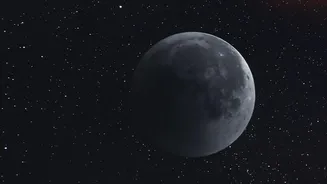
Recent advancements in computational power have allowed scientists to simulate this ancient collision with unprecedented detail. Researchers at institutions like NASA and Durham University ran supercomputer simulations at extremely high resolutions, revealing a startling new possibility. Instead of a slow-forming debris ring, these models showed that a Moon-like body could be flung directly into a stable orbit almost immediately after the impact—in a matter of hours, not millennia. In some of these simulated scenarios, a large, intact chunk of material from the collision is launched into space and quickly pulls itself into a spherical shape, becoming a protomoon in less than a day. This "immediate moon" scenario presents a radical departure from the classic, slower accretion disk model.
What Makes This Theory Different?
The rapid-formation theory helps solve a nagging problem with the classic model: the Moon's composition. If the Moon formed mostly from the debris of Theia, as the old theory suggested, it should be chemically different from Earth. Yet, studies of lunar rocks show they are isotopically very similar to Earth rocks. The new simulations show that a more direct, energetic collision could have ejected more material from Earth's own mantle to form the Moon, explaining the striking family resemblance. In this faster model, the upper layers of the Moon are made from Earth-derived material, while the deeper interior might still hold remnants of Theia. This could explain why different lunar samples sometimes show slight variations in composition.
The Key Qualification to Keep in Mind
Here’s the crucial caveat mentioned in the headline. The outcome of the giant impact—whether it creates a debris disk or an instant moon—depends heavily on the initial conditions of the colliding bodies. The new simulations suggest the "key qualification" is the temperature and material strength of Theia and the proto-Earth. Researchers found that a hotter, and therefore geologically weaker, Theia was more likely to result in a scenario where a large, intact moon forms rapidly. A colder, more solid impactor, however, was more likely to shatter and create the classic debris disk. So, the five-hour moon formation isn't a certainty; it's a possibility that depends on specific, and as-yet-unknown, properties of the worlds involved in this ancient smash-up. Scientists are not saying this proves the Moon formed in hours, but that it is physically possible under the right conditions.
Why This Changes Our Cosmic Perspective
This research does more than just refine our story of the Moon. It changes how we think about planetary formation across the universe. If large satellites can form in a flash after giant impacts, it expands the range of possible outcomes for such events. It suggests that planetary systems might be able to form and stabilize much more quickly than previously believed. The Moon itself played a critical role in Earth's evolution, stabilizing our planet's tilt and creating the tides. Understanding its violent and potentially rapid birth gives us a clearer window into the chaotic, creative processes that shaped our own world and made it habitable. The debate is far from over, but these stunning simulations provide a compelling new chapter in our quest to understand our closest celestial neighbor.