







The Colours of the Nation
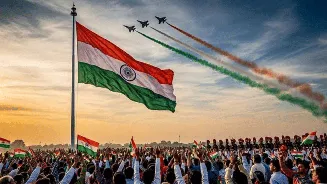
The Indian National Flag is a horizontal tricolour of India saffron (Kesari) at the top, white in the middle, and India green at the bottom, in equal proportion. Each colour was chosen to represent a specific ideal. The top saffron band signifies strength
and courage. The white middle band is a symbol for peace and truth. The green at the bottom represents the fertility, growth, and auspiciousness of the land. This combination of colours was deliberately chosen to be free of any communal undertones, instead reflecting the core values of the nation.
The Wheel of Dharma
At the heart of the white band is a navy-blue wheel known as the Ashoka Chakra. This emblem was adopted from the Sarnath Lion Capital of Emperor Ashoka. The wheel is a powerful symbol of Dharma, or the law of righteousness. It signifies that there is life in movement and death in stagnation, a reminder that the nation must constantly move forward. The 24 spokes in the chakra are symbolic of the 24 hours of the day, representing the perpetual nature of this forward march and the need for continuous progress.
A Journey Through History
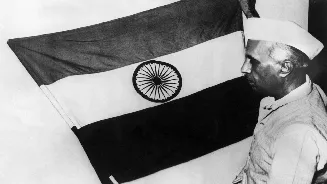
The flag in its current form was adopted by the Constituent Assembly of India on July 22, 1947, just days before India's independence. However, its design journey started much earlier. Several flags were used during the freedom struggle. In 1921, a freedom fighter named Pingali Venkayya presented a design to Mahatma Gandhi. That initial version featured red and green bands for Hindus and Muslims, with a spinning wheel (Charkha) at the centre. On Gandhi’s suggestion, a white band was added to represent other communities, and the Charkha symbolised self-reliance. To make the flag acceptable to all communities, the colours were later reinterpreted to represent ideals rather than religious groups, and the Charkha was eventually replaced by the Ashoka Chakra in the final 1947 design.
The Architect of the Flag
Pingali Venkayya, a freedom fighter from what is now Andhra Pradesh, is widely credited with designing the flag upon which the Tricolour is based. An agriculturist and geologist, Venkayya had a passion for flags and researched the flags of 30 nations before presenting his design to the Indian National Congress. His initial design in 1921, featuring the Charkha, became a powerful symbol of the independence movement. Although the final flag adopted in 1947 had modifications, such as the substitution of the Charkha with the Ashoka Chakra, Venkayya's foundational work laid the groundwork for India’s most important national symbol. Despite his immense contribution, he lived much of his later life in poverty and was only recognised posthumously.
The Rules of Respect: The Flag Code
The display of the national flag is governed by the Flag Code of India, 2002. The code specifies that the flag's width-to-length ratio must be 2:3. Originally, the law required the flag to be made only of Khadi (hand-spun cloth), but amendments have since allowed for machine-made flags of materials like polyester, cotton, wool, and silk. The code also outlines rules for respectful handling. The flag must always be in a position of honour and never touch the ground or water. It should not be used as drapery or for covering statues or tables. A damaged or soiled flag must not be displayed and should be disposed of respectfully, preferably by burning in private. These rules ensure that the symbol of national pride is always treated with the dignity it deserves.