




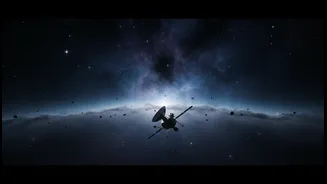
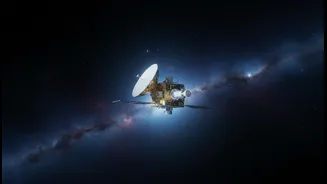


A Journey Beyond Pluto
Launched in 2006, New Horizons became a household name in July 2015 when it flew past Pluto, revealing a world of stunning complexity with nitrogen glaciers, jagged ice mountains, and hints of a subsurface ocean. It didn’t stop there. On New Year’s Day
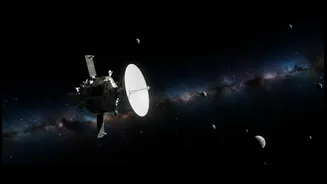
2019, the probe made history again by visiting Arrokoth, the most distant and primitive object ever explored by a spacecraft, reshaping our understanding of how planets form. But the probe's journey was far from over. After these spectacular encounters, New Horizons began its next chapter: a long cruise through the Kuiper Belt, the vast, icy region beyond Neptune. In July 2026, after a 321-day hibernation to conserve power, the spacecraft awoke, healthy and ready for its new mission nearly 9.5 billion kilometres from Earth.
What Exactly is the Heliosphere?
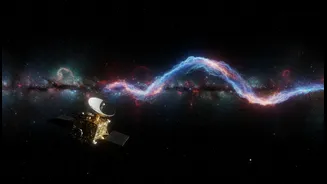
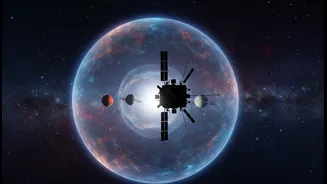
New Horizons is now functioning as a deep-space observatory, and its primary target is the heliosphere. Think of the heliosphere as a colossal, protective bubble blown by the Sun. This bubble is formed by the solar wind, a constant stream of charged particles flowing from the Sun at supersonic speeds. It extends far beyond the planets, shielding our solar system from most of the high-energy galactic cosmic rays that permeate interstellar space. This bubble isn't a simple sphere; it's thought to be shaped more like a comet, with a rounded nose and a long tail trailing behind as our solar system moves through the galaxy. Its boundary is where the outward push of the solar wind finally succumbs to the inward pressure of the interstellar medium—the gas and dust between stars.
Crossing the Final Frontier
The outer edge of the heliosphere has several layers. The first major boundary New Horizons will encounter is the "termination shock," where the solar wind begins to slow down abruptly as it collides with interstellar material. Beyond that lies the "heliosheath," a turbulent region where the solar wind is compressed and slowed further, and finally the "heliopause," the ultimate border where the solar wind stops and interstellar space begins. Only two spacecraft, Voyager 1 and 2, have crossed this final frontier. They confirmed the existence of this boundary but were launched in the 1970s with more limited technology. New Horizons, with its advanced suite of instruments, is poised to provide a much more detailed picture of this unexplored region.
A Modern Explorer's Advantage
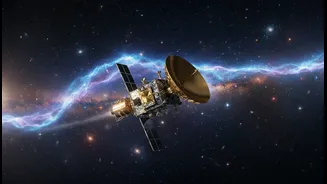
While the Voyager probes were pioneers, New Horizons carries more modern tools. Its instruments, like the Solar Wind Around Pluto (SWAP) and the Alice ultraviolet spectrograph, are designed to make more sensitive measurements of the particles, plasma, and dust in this unique environment. Even while hibernating, its instruments continued to gather data on the outer heliosphere. Now fully awake, the probe will provide crucial information on the distribution of hydrogen gas and the behaviour of the solar wind as it slows down. Scientists are using this data to create forecasting models to better predict the heliosphere's dynamic, shifting boundary, which expands and contracts with the Sun's 11-year activity cycle.
The Road Ahead
So, when will New Horizons punch through to interstellar space? Researchers estimate the probe will reach the termination shock sometime between 2029 and 2040. The wide window is because the heliosphere's boundary isn't static; it breathes in and out with solar activity. As the probe travels nearly 480 million kilometres farther from the Sun each year, it continues its groundbreaking work. The mission is a testament to long-term planning and the insatiable human curiosity to explore the unknown. Its journey teaches us not just about the Sun’s vast influence but also about our own small, protected place in a vast galaxy.