

A Cosmic Rule Breaker
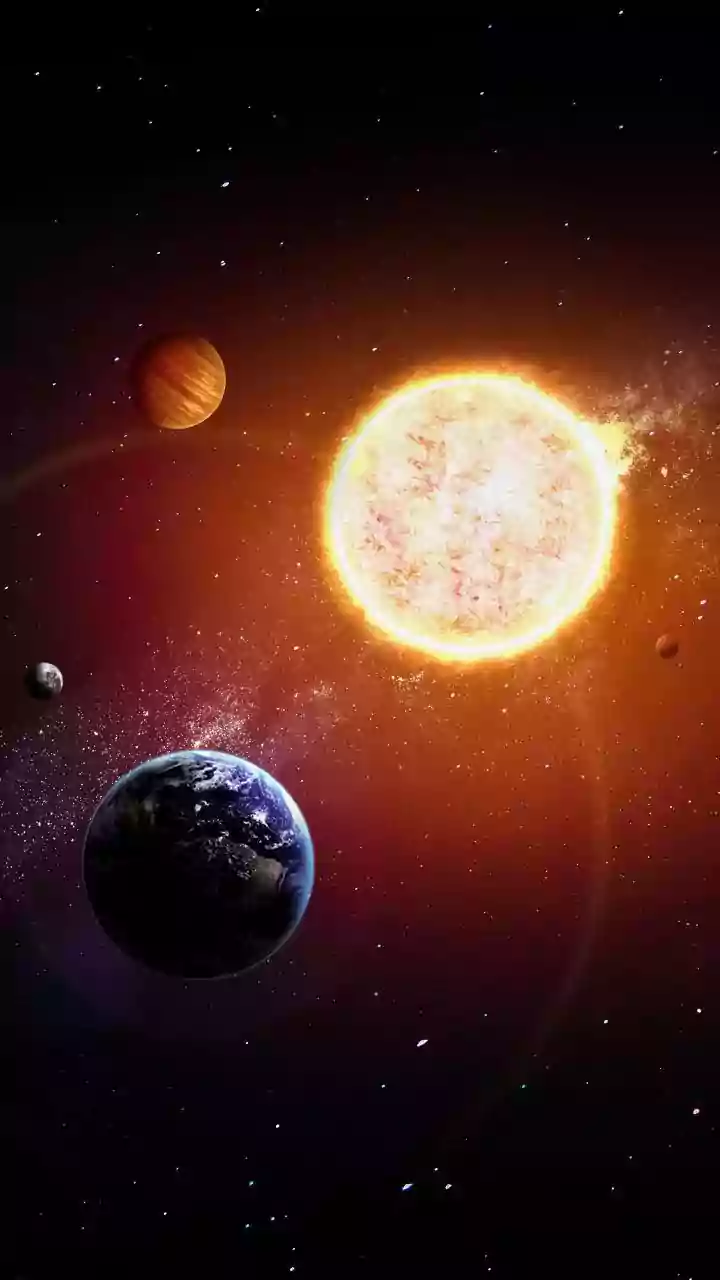
In the vast catalogue of the cosmos, stars shine in a predictable palette. Their colour is a direct indicator of their surface temperature, ranging from cooler red stars to the searing blue-white of the hottest giants. Our own Sun sits somewhere in the middle,
appearing white. Because stars emit a broad spectrum of light, any star hot enough to peak in the green part of the spectrum also emits so much red and blue light that our eyes blend it all into white. This fundamental rule of astrophysics made a truly green star seem impossible. Yet, astronomers from the University of Warwick have identified what they call the first genuinely green star, a dead star known as a white dwarf located about 326 light-years away. The star, catalogued as WD J1330+6435, isn't green because of its temperature, but because of a strange trick of chemistry happening in its atmosphere.
An Autopsy of a Dead Star
To understand this cosmic oddity, we first need to understand what a white dwarf is. When a star similar in size to our Sun runs out of fuel, it sheds its outer layers, leaving behind an incredibly dense, hot core—a white dwarf. These stellar remnants pack about half the mass of the Sun into a sphere roughly the size of Earth, making them hundreds of thousands of times denser than our planet. For a long time, it was assumed these stellar corpses also followed the temperature-to-colour rule. However, the new research shows that the extreme conditions on some white dwarfs can lead to a surprising variety of colours, including not just green, but also pink, purple, and yellow. The key is the incredibly dense atmosphere, which can be millions of times denser than the Sun's visible surface.
The Secret Ingredient: Planetary Debris
The unusual green glow of WD J1330+6435 is caused by the ghost of its former planetary system. Over billions of years, this dead star has been pulling in rocky debris from asteroids or planets that once orbited it. This material, rich in elements like calcium, lithium, and sodium, 'pollutes' the white dwarf's atmosphere. In the star's crushingly dense environment, these elements behave differently than they would elsewhere. Specifically, the sodium atoms absorb a much broader band of light than usual, effectively filtering out yellow, orange, and some red light. With these colours removed from the star's spectrum, the light that remains appears as a 'ghostly green glow' to our eyes.
A Rainbow of Stellar Corpses
The green star wasn't the only colourful discovery. The same study identified other white dwarfs with peculiar hues based on their atmospheric composition. The team found that white dwarfs with carbon dredged up from their interior can appear a deep salmon-pink, while those that have consumed planetary debris often skew towards yellow. Others with a mix of hydrogen and helium can appear cyan. While these colourful exceptions are fascinating, the research confirms that most white dwarfs still live up to their name. In a sample of 151 nearby white dwarfs, only about one in 30 showed an unusual colour. Still, this suggests the universe is littered with far more colourful stellar remnants than astronomers had ever anticipated.
Why This Cosmic Crime Scene Matters
Studying these unusually coloured stars is more than just an astronomical curiosity. Because the colours are a direct result of elements from shattered planets, they provide a unique opportunity to perform a 'cosmic autopsy' on distant planetary systems. By analysing the light from a polluted white dwarf, astronomers can measure the precise chemical makeup of the rocky bodies that once orbited it. This provides invaluable clues about how planets form and the kind of materials they are made of in other solar systems. Each colourful dead star is a crime scene, holding the chemical fingerprints of the worlds it destroyed, allowing us to piece together the story of their creation and violent end.