





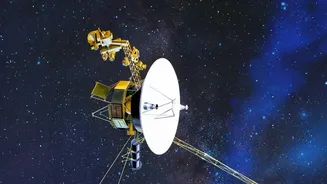
A Mission Beyond Its Years
Launched in 1977, the twin Voyager 1 and Voyager 2 spacecraft were initially designed for a five-year mission to survey the outer planets. Having spectacularly outlived that goal, they are now humanity's most distant emissaries, exploring interstellar
space — the region beyond the protective bubble of our sun. Voyager 2 is currently over 21 billion kilometers from Earth. This incredible longevity, however, comes with a fundamental challenge: its power source is steadily fading. Like its twin, Voyager 2 relies on a radioisotope thermoelectric generator (RTG), which converts the heat from decaying plutonium into electricity. This process is incredibly reliable but not infinite. Each year, the spacecraft loses about 4 watts of available power.
The Cold, Hard Problem
The problem is a classic Catch-22 of deep-space survival. The extreme cold of interstellar space requires the spacecraft to use power for heaters, which keep its scientific instruments and crucial systems like fuel lines from freezing. If the fuel lines froze, the probe would lose its ability to point its antenna toward Earth, effectively ending communication. But using heaters drains the very power that is becoming more precious with each passing day. For years, mission engineers have had to make tough choices, gradually switching off systems and even some science instruments to conserve energy. Without a new approach, the team would have been forced to turn off another one of Voyager 2's three remaining active instruments before the end of 2026.
A 'Big Bang' Solution
Engineers at NASA's Jet Propulsion Laboratory devised an inventive and risky new strategy, nicknamed the 'Big Bang'. The name refers to the fact that the maneuver involved making a coordinated swap of multiple systems all at once, a daunting task for a probe so far away that a radio signal takes over 19 hours to reach it. The plan involved simultaneously shutting down a set of power-hungry components, including some dedicated heaters and even a digital tape recorder that was kept on partly for the heat it generated. In their place, the team activated different, lower-power alternatives that could provide sufficient warmth while consuming less overall electricity. This carefully choreographed power shuffle was designed to free up just enough energy to keep all three remaining science instruments online.
Buying Precious Time for Science
The 'Big Bang' maneuver, which was successfully carried out, is not a permanent fix, but it is a critical life extension. The power savings are expected to keep Voyager 2's instruments operating for at least an additional year, postponing the next difficult shutdown decision. This extra time is invaluable for scientists studying the interstellar medium, providing continuous data from a region of space humanity has never explored before. The success on Voyager 2 has given the team confidence to apply the same strategy to its even more distant twin, Voyager 1, in the coming months. For Voyager 1, the fix could even free up enough power to restart a particle science experiment that was turned off earlier this year.