

A Star's Final Roar
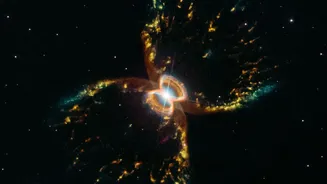
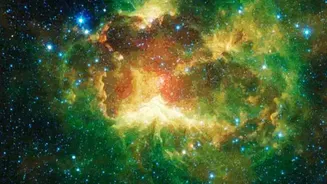
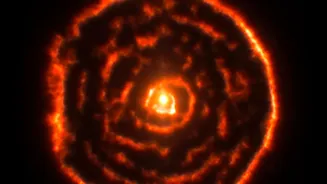
The subject of Webb's gaze is a celestial object known as NGC 2392, aptly nicknamed the Lion Nebula because of its resemblance to a lion's head and mane. But this isn't a nursery for new stars; it's a beautiful graveyard. NGC 2392 is a planetary nebula,
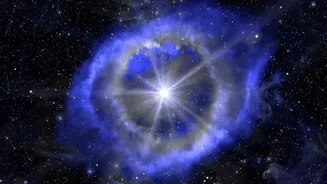
the glowing shell of gas and dust shed by a dying star similar to our own Sun. When such a star runs out of fuel, it expels its outer layers into space. The hot, dense core left behind, called a white dwarf, illuminates this ejected material, creating the spectacular structures we can observe from Earth. These nebulae are a common, though relatively brief, phase in the life cycle of most stars in the universe.
Why Webb's View Is Different
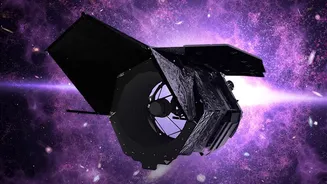
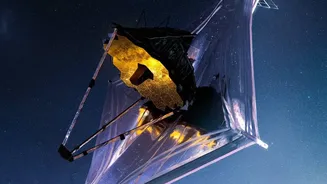
While the Hubble Space Telescope gave us iconic images of the Lion Nebula in the past, the James Webb Space Telescope sees the cosmos in a different light—specifically, infrared light. This ability allows Webb to peer through the obscuring clouds of gas and dust to reveal finer details that are invisible to the naked eye or even other telescopes. Using its powerful Near-Infrared Camera (NIRCam) and Mid-Infrared Instrument (MIRI), Webb has cut through the haze to highlight intricate features. The new images provide a much clearer view of the delicate filaments, dense clumps of dust, and the complex interplay of forces at work.
The Sculptor at the Center
The term "sculpted gas" perfectly describes what is happening in the Lion Nebula. The architect of this cosmic structure is the intensely hot white dwarf at its center—the 'button nose' of the lion. This stellar remnant is blasting out powerful radiation and stellar winds, a fast-moving stream of particles. This outflow is essentially 'cooking' the nebula from the inside out. The immense energy ionizes the surrounding gas, causing it to glow, and pushes it outward, carving a massive bubble. This process is a dynamic struggle between the star's destructive force and the resilience of the surrounding material.
Anatomy of the Lion's Mane
Webb's new portrait allows us to dissect the nebula's anatomy. The lion's 'face' is a bubble of extremely hot, ionized gas, expanding and destroying dust in its path. Further out lies the 'mane,' a shell of dust and gas that appears as a thick, cloudy ring. Here, Webb's vision truly shines, revealing that the mane isn't uniform. It's filled with remarkable, comet-like tendrils and compact clumps of dust that have so far survived the star's radiation. These dense knots are tough enough to withstand the stellar onslaught, and their tails show material streaming away, protected by the dense clumps in front.
A Fleeting Cosmic Masterpiece
As stunning as it is, the Lion Nebula is a fleeting phenomenon on a cosmic timescale. It has taken thousands of years for the dying star's outflow to shape the gas and dust into its current form. But the expansion continues, and astronomers estimate that the entire structure will dissipate into interstellar space in about 10,000 years. This makes images from Webb so valuable; they are a snapshot in time, capturing a dynamic process of stellar death as it unfolds. Each detail helps astronomers build a better model of how sun-like stars evolve and enrich the galaxy with heavier elements in their final act.