







A Planet No More
For 76 years, Pluto was the ninth and final planet in our solar system. Then, in August 2006, the International Astronomical Union (IAU) voted to reclassify it. The group established a new definition for a planet: a celestial body that orbits the sun,
is massive enough for its own gravity to make it round, and has "cleared the neighbourhood around its orbit." Pluto met the first two criteria but failed the third, as its orbit lies within the crowded Kuiper Belt. It was officially designated a "dwarf planet," a move that caused an immediate public and scientific outcry. The decision felt like a demotion for a beloved celestial underdog, and the word "plutoed"—meaning to devalue something—was even named the 2006 Word of the Year by the American Dialect Society.
A Decade-Long Journey
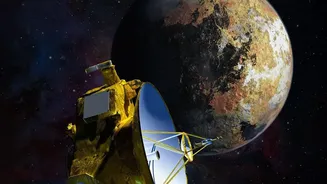
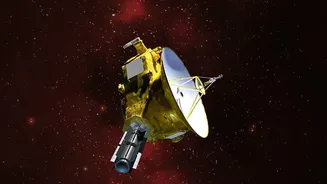
Coincidentally, in January 2006, just months before the controversial vote, NASA launched the New Horizons probe. The mission's primary target was the very world whose status was about to be debated. The piano-sized spacecraft embarked on a silent, five-billion-kilometre journey across the solar system. For nine years, it travelled towards the outer fringes, an emissary from Earth to a world we had only ever seen as a faint, blurry dot. As the probe closed the distance in 2015, the excitement was palpable. Scientists and the public alike prepared for humanity's first-ever close encounter with the former ninth planet, ready to transform it from a point of light into a real place.
A World Revealed
On July 14, 2015, New Horizons flew within 12,500 kilometres of Pluto, and the images it sent back were staggering. They revealed a world of stunning complexity and beauty that defied all expectations. The most iconic feature was a massive, heart-shaped glacier of frozen nitrogen, later named Tombaugh Regio. The probe discovered towering mountains made of water ice, vast plains, and evidence of flowing glaciers. It captured images of a hazy blue atmosphere and found that Pluto wasn't an inert ball of ice, but a geologically active world. Its largest moon, Charon, was equally fascinating, with giant canyons and a mysterious reddish polar cap. These findings completely rewrote the textbooks on outer solar system bodies.
The Comeback Kid of the Solar System
The data from New Horizons did more than just provide scientific insights; it gave Pluto a personality. The close-up images of its varied and active surface captured the public imagination in a way no debate over classification ever could. Suddenly, Pluto was no longer just a casualty of astronomical semantics—it was a dynamic and intriguing world. The mission revealed a world far more complex than scientists had anticipated, with some even finding evidence pointing to a possible liquid water ocean beneath its icy crust. The discoveries reignited the debate about its planethood, with the mission's principal investigator, Alan Stern, remaining a vocal advocate for its planetary status. The mission showcased the power of exploration to inspire wonder and deepened our understanding of the distant, icy realms of our solar system.