


A Ghost in the Solar Machine
Scientists have long worked to perfect models of the Sun, but a few persistent mysteries remain. For example, our star has an unusually low amount of the element lithium. Now, a new theory published in the journal Monthly Notices of the Royal Astronomical
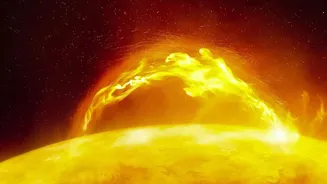
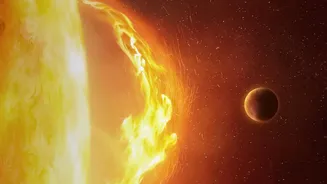
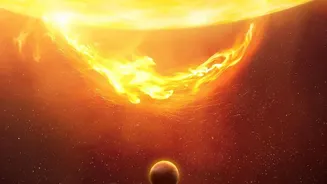
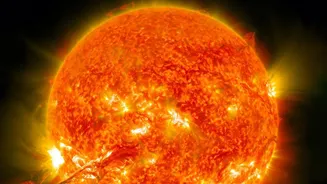
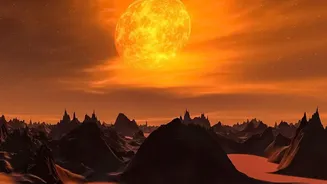
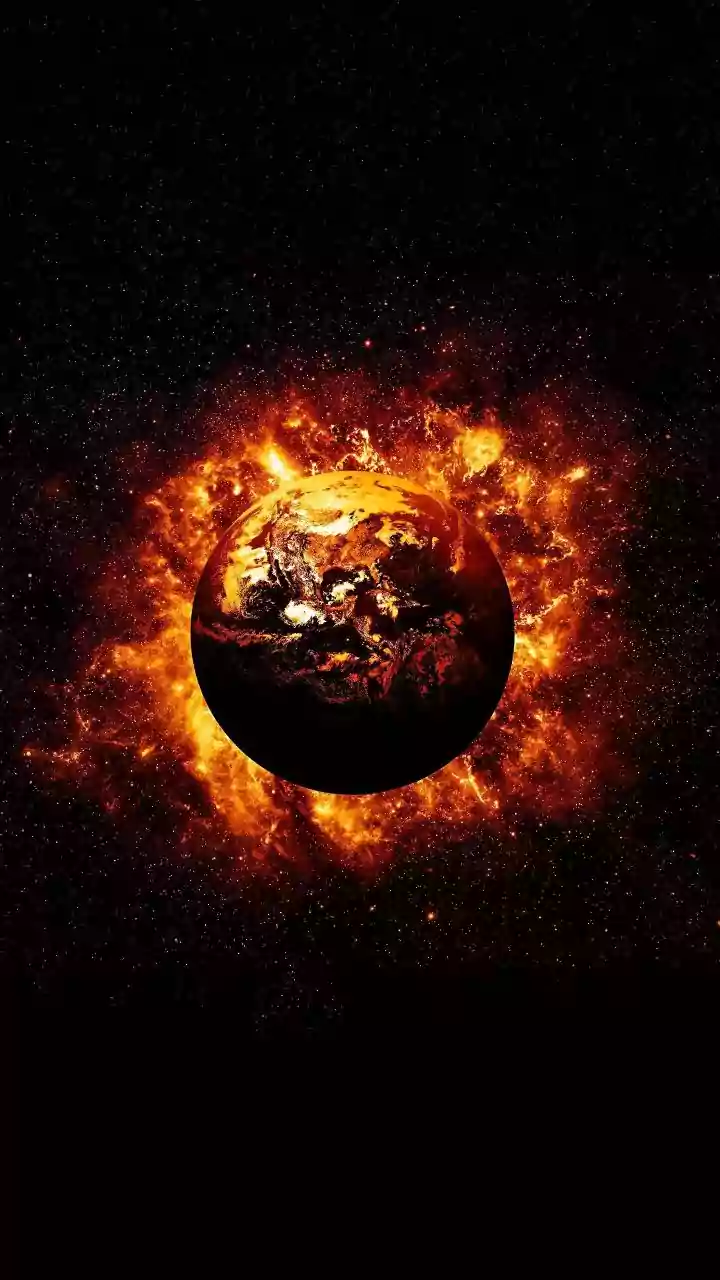
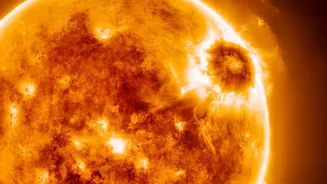
Society proposes a startling explanation for this and other anomalies: billions of years ago, the young Sun may have devoured a planet. Researchers, including Professor Mutlu Yildiz of Ege University in Turkey, suggest that a 'super-Earth'—a rocky world between five and ten times the mass of our own planet—spiraled inward and was consumed. This cosmic meal could have permanently altered the Sun's chemical composition and internal structure, leaving traces that endure to this day.
A Chaotic Beginning
The early solar system was a violent and chaotic place. It was filled with protoplanets, or large planetary embryos, that collided and coalesced to form the planets we know today. It’s widely accepted that a Mars-sized protoplanet named Theia slammed into early Earth, creating the debris that formed our Moon. The new research explores a similar scenario, but one where the victim was not another planet, but the Sun itself. Computer models suggest that a super-Earth could have formed in the inner solar system, perhaps even closer to the Sun than Mercury, before gravitational forces sent it on a collision course. This idea also provides a potential solution to another puzzle: why our solar system lacks the close-orbiting super-Earths that are commonly found around other stars.
Searching for Solar Fingerprints
The theory, while dramatic, is not just speculation. It makes specific, testable predictions. Scientists believe the evidence for this planetary ingestion could be found by studying the Sun's interior. The primary tool for this is helioseismology, which analyzes vibrations and sound waves on the Sun's surface to map its inner structure, much like how seismologists use earthquakes to study Earth's core. If a massive planet was absorbed, its heavier elements—what astronomers call 'metals'—would not have mixed evenly throughout the star. Instead, this material could have settled in a distinct layer deep inside, altering the way energy moves within the Sun and leaving a subtle but lasting structural signature. The models show that the ingestion of a planet five to ten times Earth's mass could neatly explain several observed discrepancies between standard solar models and reality.
What This Changes About Our Story
If confirmed, this hypothesis would be more than just a fascinating piece of trivia. It would fundamentally reshape our understanding of how stars and their planetary systems evolve. It would show that the Sun's history is not just one of smooth, predictable nuclear fusion, but was also shaped by the violent, messy process of planet formation. Proving that a star can swallow one of its own planets and retain the evidence for billions of years would be a landmark discovery. It suggests that stellar evolution and planetary migration are deeply interconnected. Furthermore, identifying these chemical signatures in our own Sun would help astronomers interpret observations of distant stars, reinforcing the idea that planet swallowing is a common, rather than rare, chapter in the life of a star.