





Reading a Galaxy's Fossil Record
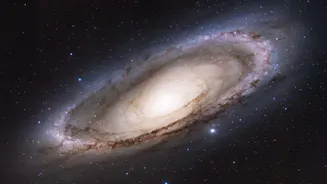
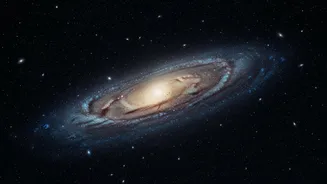
Imagine trying to reconstruct the history of a bustling city by studying its population. That's essentially what astronomers have done for the Andromeda galaxy, located 2.5 million light-years away. Using a treasure trove of data from the Hubble Space
Telescope, scientists meticulously mapped and measured nearly 200 million individual stars. This cosmic census is crucial because stars are the fossil record of a galaxy. Their color and brightness act as time capsules. Young, massive stars burn hot and blue but die quickly, while older, smaller stars glow red and can live for trillions of years. By charting the distribution of these stellar populations, researchers created the most detailed timeline yet of Andromeda's recent history.
The Billion-Year Wind-Down
The findings, published in The Astrophysical Journal, paint a picture of a galaxy that is gently winding down. The analysis shows that about 2 billion years ago, Andromeda likely experienced a massive burst of star formation, probably triggered by a merger or close encounter with another galaxy. But since that flurry of activity, it has been a long, slow decline. Around 500 million years ago, the galaxy was still churning out new stars at a respectable rate, equivalent to about one new Sun's worth of mass per year. By 40 million years ago, that rate had been cut in half, and today, it has dwindled to just one-fifth of a solar mass annually, marking a significant slowdown.
A Fading Ring of Fire
This slowdown isn't happening uniformly across the galaxy. The study revealed that much of Andromeda's most recent star-making activity has been concentrated in a vast ring structure about 32,000 light-years from the galactic center. It is the fading of this stellar nursery that is primarily driving the galaxy-wide decline. It’s not that the galaxy is running out of the necessary gas and dust to create stars. Instead, it appears to be a natural aging process. As lead author Tobin Wainer of the University of Washington described it, "It's just like after running a marathon, sometimes you've got to take a bit of a breather."
A Case of Galactic Interference?
Astronomers are also investigating a potential cosmic suspect for some of the localized slowdown: Andromeda's small companion galaxy, Messier 32 (M32). The team found a noticeable drop in star formation in the region of Andromeda's disk near M32, which began around 60 million years ago. While researchers cannot yet definitively prove that a past interaction with M32 is the cause, the timing and location make it the 'most likely suspect' for disrupting the stellar nurseries in that specific area.
A Glimpse into Our Own Future
Studying Andromeda is more than just an academic exercise; it's like looking at a future version of our own Milky Way. Both galaxies are large spirals of similar size and structure. Understanding why Andromeda's star formation is tapering off provides valuable clues about how all spiral galaxies age and evolve from active, star-forming systems into quieter ones. As Andromeda and the Milky Way are on an eventual collision course—though the exact timing and nature of that event are still debated by scientists—learning about our neighbor's life cycle helps us better forecast the long-term destiny of our own galactic home. Future observatories, like NASA's Nancy Grace Roman Space Telescope, are expected to provide an even wider and more detailed view, helping to solve the lingering mysteries of our beautiful, aging neighbor.