




Meet the 'Black Hole Star'
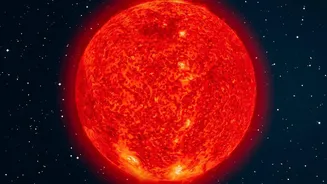
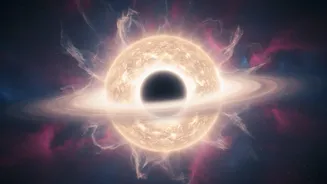
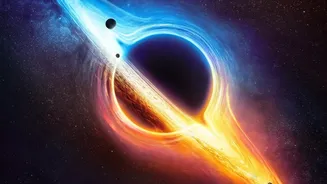
Astronomers, including a team from MIT, have identified an object that challenges the neat categories of stars and black holes. Dubbed a "black hole star," this strange entity, formally named MoM-BH-1, resembles a colossal star but produces energy on a scale
that only a black hole can achieve—about 100 billion times more than any known star. Spotted by the James Webb Space Telescope (JWST), this object appears as a bright red dot dating back to just a few hundred million years after the Big Bang. Instead of being powered by nuclear fusion like a regular star, scientists believe it consists of a huge, dense cloud of hydrogen gas with a rapidly feeding black hole at its core.
A New Class of Cosmic Object
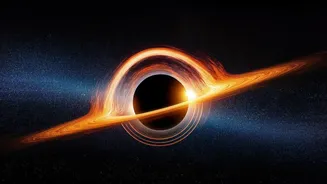
So, what makes this different from a typical quasar, which is also a supermassive black hole feeding on surrounding matter? The key distinction is its appearance. While quasars are known for their pancake-like accretion disks, a black hole star is so enshrouded in a dense cocoon of gas that it radiates light in a manner similar to a star's photosphere. This massive gas envelope, roughly the size of our solar system, is being energized by the central black hole, causing it to glow brilliantly. The object's unique, intensely red color helped it stand out to researchers, who realized it didn't fit any known classification.
Solving the Mystery of the 'Little Red Dots'
The discovery of MoM-BH-1 could be a major breakthrough in explaining another puzzle presented by the JWST: the appearance of numerous "little red dots" in deep-space images. These mysterious dots have baffled scientists, but the black hole star model provides a compelling explanation. It suggests that these could be an early stage in the life of supermassive black holes, a phase where they grow incredibly quickly while still hidden within their gassy stellar cocoons. This phase of rapid growth, known as super-Eddington accretion, was predicted by theories but had not been clearly observed until now.
Rethinking Black Hole Growth
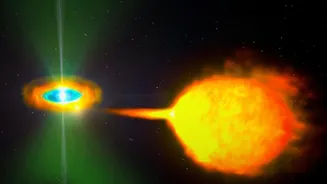
The existence of black hole stars forces a rethink of how the universe’s largest black holes came to be. Traditionally, scientists have struggled to explain how supermassive black holes grew to billions of times the mass of our sun so early in the universe's history. These objects provide a potential answer. They represent a mechanism for extremely rapid growth, where a black hole consumes its surrounding gas envelope from the inside out. The central black hole within MoM-BH*-1 is estimated to be about 100,000 times the mass of our sun, a significant size for such an early object. This discovery offers a crucial, observable link in the evolutionary chain of cosmic giants, showing how they might have packed on mass in their infancy.