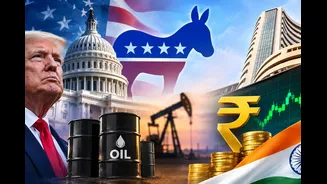





With the dust now settled on the US midterm elections, the focus for New Delhi and Indian businesses shifts to Washington's new political landscape. What does a divided government mean for the crucial India-US economic partnership, particularly on trade
and tariffs?
A New Power Dynamic in Washington
The 2026 midterm elections have delivered a significant political shift in the United States, with the Democratic Party reportedly gaining control of both the House of Representatives and the Senate. This result serves as a major rebuke to the sitting Republican administration and reshapes the power dynamics in Washington for the next two years. For India, this outcome introduces both new opportunities and fresh uncertainties. A weakened presidency means the White House's ability to push through its legislative agenda will be constrained. However, a President seeking foreign policy wins to demonstrate influence could intensify pressure on India to finalize a bilateral trade agreement.
The Persistent Question of Tariffs
Trade has been a focal point of friction, with Indian exporters navigating a volatile tariff environment over the past few years. While a framework agreement in February 2026 saw some punitive tariffs removed and others reduced, uncertainty has remained a constant. Analysts believe the midterm results are unlikely to lead to an immediate or complete reversal of existing tariff structures. However, a Democrat-controlled Congress will likely increase scrutiny of the President's use of tariffs, potentially concerned about their impact on American consumers and businesses. This could curb the administration's ability to impose new tariffs unilaterally, leading to a more predictable, if not entirely smooth, trade environment. Yet, some analysts warn that the President could still use executive powers to apply pressure, making tariff-related volatility a continuing risk.
Momentum on the Trade Deal?
The election outcome has sparked debate on the future of the long-negotiated India-US trade deal. One school of thought suggests that a politically weakened President might be eager to secure a quick victory on the foreign policy front, potentially accelerating talks. This could put pressure on New Delhi to make concessions, particularly on market access for American agricultural and industrial goods. Conversely, other experts believe the results give India more breathing room and leverage. With Congress now acting as a check on the White House, Indian negotiators may feel less urgency and be in a stronger position to push for a more balanced and favourable agreement that protects domestic interests. For now, the path forward for the bilateral trade agreement appears complex, caught between a President needing a win and a Congress demanding more oversight.
Beyond Trade: Continuity and Cooperation
Despite the political turbulence in Washington, the foundational pillars of the India-US relationship are expected to remain strong. There is broad bipartisan consensus in the US on the strategic importance of India, particularly in the context of the Indo-Pacific. Key areas of cooperation, such as defence partnership, technology collaboration in fields like AI and semiconductors, and building resilient supply chains, are likely to continue their upward trajectory. This underlying strategic convergence means that even with disagreements over trade, the broader partnership is not at risk. For Indian businesses, this suggests that while specific market access issues may persist, the overall framework for economic engagement remains robust and supported across the American political spectrum.
Key Areas to Watch
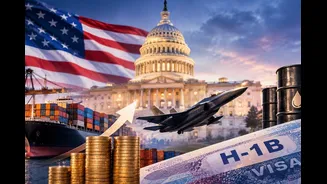
Beyond the headline tariff rates, several other policy areas will be critical for Indian interests. Immigration, especially the H - 1B visa program, could see a more predictable approach under a Democratic Congress, providing some relief for India ' s vital IT sector. The US stance on issues like India ' s energy imports will also be closely monitored. While Democrats may bring their own set of priorities, such as linking trade to labour and environmental standards, their control of Congress opens new institutional channels for Indian officials to engage and advocate for the nation ' s interests. The changing political environment provides India with an opportunity to diversify its outreach beyond the White House and build stronger, more durable coalitions on Capitol Hill.