




An Ambitious Five-Year Journey
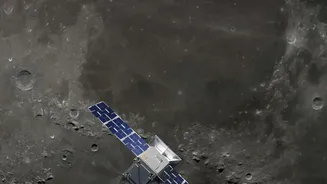
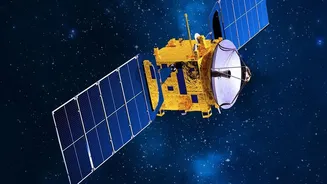
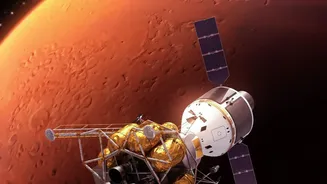
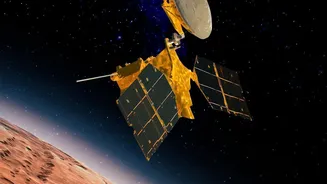
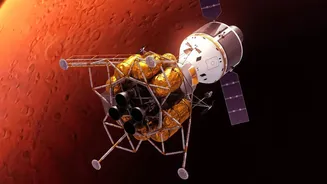
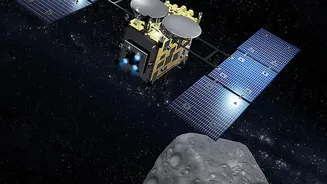
The Martian Moons eXploration (MMX) mission, which launched in October 2026, is a complex, five-year endeavour. After a year-long journey to the Red Planet, the robotic spacecraft is scheduled to arrive in Mars's orbit in 2027. It will then spend approximately
three years conducting detailed observations of both moons. The primary goal is to touch down on Phobos, the larger and closer of the two moons, collect at least 10 grams of surface material, and then return that precious cargo to Earth. If successful, the sample capsule will land in Australia in 2031, marking the first time material from the Martian system has ever been brought back for study.
The Puzzling Moons of Mars
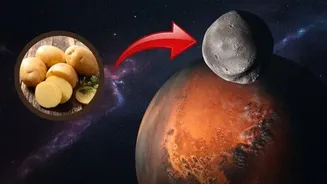
Phobos and Deimos are unlike most other moons in the solar system. Discovered in 1877, they are incredibly small and irregularly shaped. Phobos, the larger one, is only about 22 kilometres across, while Deimos is even smaller at about 13 kilometres. They look more like captured asteroids than fully-fledged moons. Their orbits add to the mystery. Phobos orbits incredibly close to Mars, completing a circle in just over seven hours, while Deimos is further out. Strangely, Phobos is slowly spiralling closer to Mars and is expected to be torn apart by the planet's gravity in tens of millions of years, possibly forming a ring.
The Central Mystery: Captured Asteroids or Giant Impact?
The core scientific question MMX aims to answer is how Phobos and Deimos formed. There are two leading theories, and the evidence is contradictory. The 'capture hypothesis' suggests they are asteroids that strayed too close to Mars and were trapped by its gravity. Their dark, cratered surfaces resemble certain types of primitive asteroids. The competing 'giant impact hypothesis' proposes that a massive object, perhaps a protoplanet, crashed into a young Mars, sending a cloud of debris into orbit that eventually clumped together to form the moons. The fact that they have stable, circular orbits close to Mars's equator supports this idea, as captured asteroids would likely have more eccentric orbits.
How MMX Will Find the Answer
The key to solving this puzzle lies in the composition of the moons. If they are captured asteroids, their makeup should be rich in water and organic materials, similar to other small bodies from the outer solar system. If they were born from a giant impact, they should be made of material from Mars itself, which would have been sterilised of such materials by the intense heat of the collision. The MMX spacecraft is equipped with a suite of scientific instruments to analyse the moons remotely. More importantly, the mission includes a small rover, a joint German-French contribution named IDEFIX, which will explore the surface of Phobos. The ultimate proof, however, will come from the sample returned to Earth. Scientists will use advanced laboratory equipment, far too large to send on a spacecraft, to analyse the grains from Phobos and determine their chemical and mineralogical history.
A Global Effort for Cosmic Clues
While led by Japan, MMX is a truly international collaboration. NASA has provided a key instrument called MEGANE, a spectrograph that will map the elemental composition of Phobos, as well as technology for one of the two sample collection systems. The European Space Agency (ESA), along with the French (CNES) and German (DLR) space agencies, are also significant partners, contributing the IDEFIX rover and other expertise. This global effort highlights the universal importance of the mission's questions. Uncovering the origin of the Martian moons will not only tell us about the history of Mars but will also provide crucial insights into how planets and their moons form throughout the solar system, including our own.