






A New Era of Solar Gazing
Perched atop the Haleakalā volcano in Maui, Hawaii, the Daniel K. Inouye Solar Telescope is changing our relationship with the Sun. As the largest and most powerful solar telescope in the world, its massive four-metre primary mirror collects an unprecedented
amount of sunlight. This allows it to produce images of our star with stunning clarity, resolving features on the solar surface as small as 20 kilometres wide. To put that in perspective, it’s like seeing an object the size of Manhattan from a great distance. This incredible capability is thanks not only to its mirror but also to an advanced adaptive optics system that counteracts the blurring effects of Earth's atmosphere, delivering crystal-clear views. Since beginning operations, it has consistently provided breathtaking images that are not just beautiful, but are packed with scientific data, opening a whole new window into the physics of our star.
Inside the Edge of a Sunspot
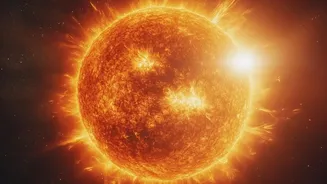
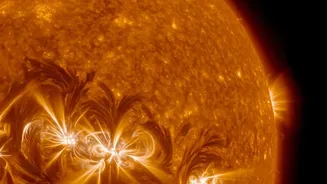
Sunspots are familiar dark patches on the Sun, but they are far from simple blemishes. They are complex, cooler regions created by intense magnetic fields that suppress the normal convection of hot plasma from the Sun's interior. For centuries, scientists have studied them, but the intricate details of what happens at their boundaries—the area between the dark central umbra and the lighter, filamentary penumbra—have been largely a mystery. This boundary is a chaotic place where different flows of plasma, governed by powerful magnetic fields, slide past each other. Previous telescopes could see these areas, but the view was often blurry. With Inouye's resolution, what was once a fuzzy interface has snapped into sharp focus, revealing a landscape of constant, dynamic motion.
From Theory to Live Observation
For years, physicists have used computer simulations and theoretical models to predict what might be happening in these magnetically active regions. One long-predicted phenomenon is the Kelvin-Helmholtz instability (KHI), which occurs when fluids or plasmas moving at different speeds create a shearing effect, resulting in vortices and swirls, much like wind creating waves on water. While observed elsewhere in the solar system, like on Jupiter, it had never been seen directly on the Sun. Inouye's latest observations have provided the first unambiguous confirmation of these instabilities on the Sun's surface. Scientists can now see tiny, whirlpool-like vortices churning along the edges of magnetic areas. This transforms the sunspot boundary from a theoretical concept into a live physics laboratory, where models can be tested against real-world data in real-time, an incredible leap for solar physics.
Why This Cosmic Detail Matters Here on Earth
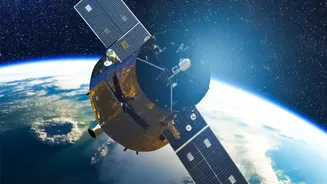
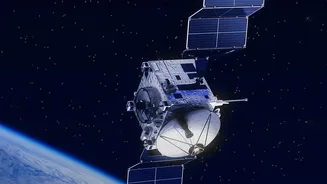
Understanding the microscopic physics of the Sun has profound practical implications. The magnetic tangles and rearrangements in sunspots are the engines behind solar flares and coronal mass ejections (CMEs)—massive explosions that hurl radiation and charged particles into space. This phenomenon is known as space weather, and when directed at Earth, it can have serious consequences. Major solar storms can disrupt radio communications, damage satellites vital for GPS and telecommunications, and even overload electrical power grids. By observing the fundamental processes like Kelvin-Helmholtz instabilities, scientists can refine their models of how magnetic energy builds up and is released. This detailed understanding is a critical step towards more accurately predicting space weather, giving us more time to prepare for and mitigate the effects of the Sun's inevitable outbursts. It's a reminder that the physics 93 million miles away can have a direct impact on our technology-dependent lives.