







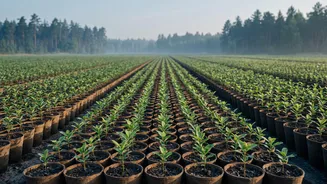

The Promise of a Greener Planet
Over the last decade, a wave of optimism spurred major international commitments to heal the world's forests. The most significant of these is the Bonn Challenge, launched in 2011, which set a goal to bring 350 million hectares of degraded and deforested
land into restoration by 2030. This was reinforced by the 2014 New York Declaration on Forests, which folded the Bonn Challenge into its own broader goals and was endorsed by over 200 governments, companies, and civil society groups. These pledges promised a future with improved climate stability, restored biodiversity, and enhanced livelihoods for millions of people who depend on forests. The vision was clear: to turn the tide on centuries of deforestation and begin rebuilding these vital ecosystems.
A Sobering Reality Check
Despite the bold promises, the latest assessments paint a concerning picture. A recent report from the UN's Food and Agriculture Organization (FAO) highlighted that while over a billion hectares have been pledged for restoration globally, only about one-fifth of that area is actually seeing restoration efforts. An analysis by the International Union for Conservation of Nature (IUCN) found that just over 124 million hectares are documented as being under restoration, which represents only about 10.4% of total commitments. Progress has been highly uneven. South Asia has shown the highest delivery rate, meeting 40% of its commitments, largely through agricultural and land productivity improvements. In contrast, Sub-Saharan Africa, despite ambitious initiatives like the Great Green Wall, has achieved only 5% of its massive 480-million-hectare pledge. The global deforestation curve has not yet begun to bend in the right direction.
The Root Causes of Stalled Progress
The gap between pledges and progress is not for a lack of good intentions but is rooted in complex, systemic barriers. A primary obstacle is a severe lack of funding. A survey of forestry teams revealed that 95% do not have enough funding to implement their projects. Public budgets are limited, and attracting private investment has been difficult because many of the benefits of restoration, like biodiversity and clean water, are not easily monetized. Another major issue is land tenure. Indigenous peoples and local communities have legal rights to only a fraction of the forest lands they occupy, which leaves both the people and the forests vulnerable and excludes them from decision-making. Furthermore, there is often a lack of political will, with forests sometimes treated as sources of political patronage rather than vital ecosystems to be preserved. This is compounded by a shortage of trained staff, technology for monitoring, and access to a diverse supply of native seeds.
Why This Matters for India and the World
The failure to meet restoration targets has profound consequences. Forests are home to 80% of the world's terrestrial biodiversity and are crucial for the livelihoods of nearly a third of the global population. Inaction on land degradation carries a staggering annual cost, estimated to be between USD 878 billion and USD 6.3 trillion. For India, which has made the largest single pledge to the Bonn Challenge—26 million hectares—progress is a matter of national priority. As of June 2026, India reported having brought nearly 22 million hectares under restoration, putting it on a positive track. However, the global slowdown affects everyone. Slower restoration means slower progress on climate change, as forests are immense carbon sinks. It threatens water security, food systems, and the resilience of economies worldwide. The fate of these global pledges is not an abstract environmental issue; it directly impacts food on the table, the stability of our climate, and the health of our communities.