






An 87-Year-Old Problem
Since 1939, mathematicians have been wrestling with a challenge known as the Jacobian Conjecture. Proposed by German mathematician Otto Keller, the conjecture deals with a specific type of mathematical function called a polynomial map. In simple terms,
the conjecture proposed that if a certain condition was met—that its 'Jacobian determinant' was a non-zero constant—the function must be reversible. Proving or disproving this has been a notoriously difficult task, landing it on a prestigious list of major unsolved problems for the 21st century compiled by mathematician Stephen Smale. For nearly nine decades, the conjecture remained an open question, with some experts predicting a human solution could still be a century away.
A Breakthrough on a Sunday Night
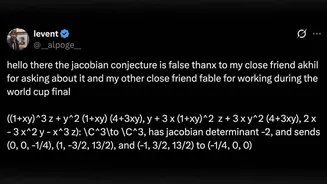
The breakthrough came not from a university mathematics department, but from a researcher at the AI company Anthropic. Levent Alpoge, a Turkish-American mathematician, found the answer with the assistance of Anthropic's advanced AI model, Claude Fable 5. The discovery reportedly happened on a Sunday night while Alpoge was watching the FIFA Club World Cup final. After a friend mentioned the problem, Alpoge tasked the AI model with exploring the Jacobian Conjecture. Instead of trying to prove it, the AI produced something that had eluded mathematicians for generations: a concrete counterexample.
The Elegant Takedown
The counterexample is a 216-character formula that defines a polynomial map in three dimensions. This formula is the mathematical equivalent of a silver bullet. It satisfies the conjecture's initial condition, possessing a constant Jacobian determinant of negative two. However, it fails the crucial final test. The formula takes three different input points and maps them all to the exact same output. A function that collapses multiple inputs into one cannot be reversed, directly contradicting the conjecture's claim of universal reversibility. Because the counterexample is so short and computational, its validity can be checked quickly and independently. Prominent mathematicians like Terence Tao have already reviewed and confirmed that the counterexample successfully disproves the conjecture for three dimensions and higher.
Rewriting the Rules of Discovery
While solving an 87-year-old problem is a major headline, the deeper story is about how it was solved. This event marks a pivotal moment for the role of artificial intelligence in pure research. The AI did not simply run calculations; it explored a complex mathematical space to find a creative and non-obvious path to a solution. This represents a shift from AI as a mere tool for data analysis to a partner in creative and intellectual discovery. The true 'rewriting of modern mathematical thinking' suggested by the headline may not come from this specific result, but from the new reality that human-AI collaboration can break through barriers that have stood for nearly a century. It suggests a future where the pace of discovery in science and mathematics could be dramatically accelerated, as researchers equipped with these powerful new systems tackle other long-standing challenges.