



A Star in Its Youth
Located just 63 light-years from Earth, the Beta Pictoris system is a celestial playground for astronomers. At only about 23 million years old, it’s a stellar infant compared to our own 4.6-billion-year-old Sun. This youth is precisely what makes it so
important. The system is surrounded by a vast, bright disk of dust and debris—the leftover raw materials from which planets are born. First imaged in 1984, this was our first-ever direct look at a debris disk around another star, providing a rare snapshot of a planetary system in its turbulent, formative years. For decades, scientists have studied this disk, finding evidence of colliding planetesimals and even exocomets, making it a perfect laboratory for understanding how solar systems like our own came to be.
Meet the New Family Member
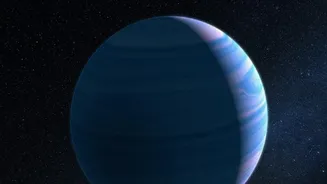
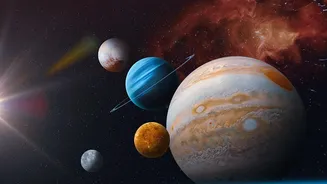
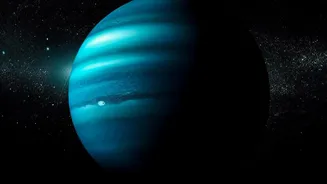
The newly discovered planet, Beta Pictoris d, joins its two previously known siblings, Beta Pictoris b and c. All three are gas giants, but the newcomer is the runt of the litter. While planets b and c are behemoths, each weighing in at roughly ten times the mass of Jupiter, Beta Pictoris d is a more modest 2.4 times Jupiter's mass. This makes it one of the least massive planets ever to be directly imaged from the ground. It orbits its star at a distance of about 26 astronomical units (AU), which would place it between Uranus and Neptune in our solar system, and takes approximately 91 years to complete one orbit. Because the system is so young, the planet is still glowing with the heat of its own formation, radiating at a temperature of around 325 degrees Celsius.
A Planet Playing Hide-and-Seek
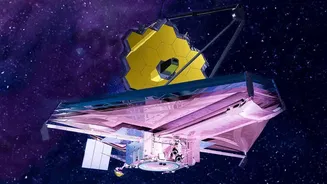
Finding Beta Pictoris d was a technological feat that involved both new observations and some clever astronomical archaeology. Two independent teams of astronomers made the discovery. One team, using the European Southern Observatory's Very Large Telescope (VLT), was initially observing the brighter planet b when they noticed another, much fainter object. This prompted them to dig through more than a decade of archival data, where they found faint traces of the planet hiding in plain sight in images dating back 11 years. Another team, using NASA's James Webb Space Telescope (JWST), found the planet not by seeing its light directly, but by detecting the unique chemical fingerprint of its atmosphere. The JWST’s spectrographs identified methane, carbon monoxide, and water vapour, confirming the presence of a planet that was otherwise lost in the glare of the star's dusty disk.
Why This Discovery Is a Big Deal
The discovery of a third planet makes Beta Pictoris only the second star system, after HR 8799, to have more than two directly imaged planets. This provides an unprecedented opportunity to study multiple giant planets that all formed from the same material in the same environment. Furthermore, the existence of a planet like Beta Pictoris d had long been predicted. Its mass and its location at the inner edge of the debris disk may finally explain the disk's peculiar, sharply-defined structure, suggesting the planet's gravity is 'sculpting' the material around it. The discovery also pioneers a new method for finding exoplanets. By using spectroscopy to find atmospheric signatures, astronomers can now hunt for worlds hidden in complex, dusty environments that were previously impossible to probe with traditional imaging.