



The Universe's Oldest Light
Imagine a snapshot of the universe when it was just a baby, only about 380,000 years old. Before this time, the cosmos was a hot, dense, opaque fog of plasma. But as it expanded and cooled, protons and electrons combined to form the first atoms, making
the universe transparent. The light that was freed in that moment has been travelling through space ever since, and we can still detect it today. This ancient light is called the Cosmic Microwave Background, or CMB. It is essentially a fossil, an all-sky map of the infant universe, carrying information about the conditions at the dawn of time. For decades, astronomers have studied the CMB's faint temperature variations to understand everything from the Big Bang to the composition of the cosmos.
The Supermassive Mystery
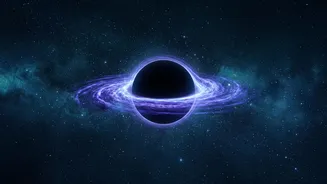
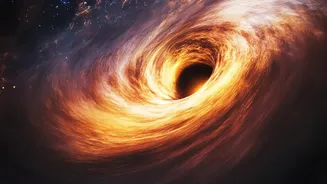
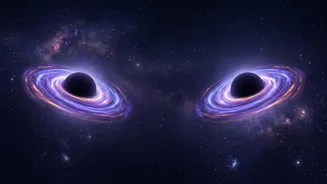
At the heart of most massive galaxies, including our own Milky Way, lurks a supermassive black hole—an object millions or even billions of times more massive than our sun. A major puzzle in cosmology is how these giants grew so big, so quickly. Astronomers have found enormous black holes that were already fully formed when the universe was less than a billion years old. This timeline is challenging to explain with standard models of black hole growth, where they start small and feed on gas and stars over aeons. Some theories suggest they might have grown from massive 'seeds' in the early universe, or that they are primordial black holes formed moments after the Big Bang itself. The problem is that these early behemoths are incredibly distant and difficult to study directly, leaving scientists searching for new ways to test their origins.
A Shadow on the Dawn
This is where the ancient cosmic light comes in. One ingenious method involves using the CMB as a backlight to probe the environments of black holes. As photons from the CMB travel across the universe for billions of years, they occasionally pass through galaxy clusters containing hot, high-energy gas. When this happens, the photons can be given a tiny energy boost by scattering off the electrons in the gas. This distortion, known as the Sunyaev-Zeldovich (SZ) effect, creates a unique signature—a subtle change in the CMB's temperature in that direction. Scientists can look for this effect around regions where black holes are expected to be. The gas accreting onto a black hole, or the powerful jets they emit, heats the surrounding medium, creating the precise conditions needed to produce the SZ effect. By searching for these faint 'shadows' or distortions in the CMB, astronomers can map the influence of black holes on their surroundings, even when the black holes themselves are invisible.
What the Test Reveals
This technique provides a powerful, independent way to test models of black holes. For instance, some theories propose that a significant fraction of the universe's mysterious dark matter might be composed of 'stupendously large' primordial black holes. Recent analysis of the CMB, however, shows that it is smoother than it would be if the universe were filled with such gigantic objects, placing tight constraints on this idea. The CMB can also be used to test theories about how black holes grow. The specific signature of the SZ effect can reveal the density and temperature of the gas around a black hole, offering clues about its feeding habits and how it injects energy back into its host galaxy. This helps astronomers refine their models of co-evolution, the idea that galaxies and their central black holes grow in tandem over cosmic history.